
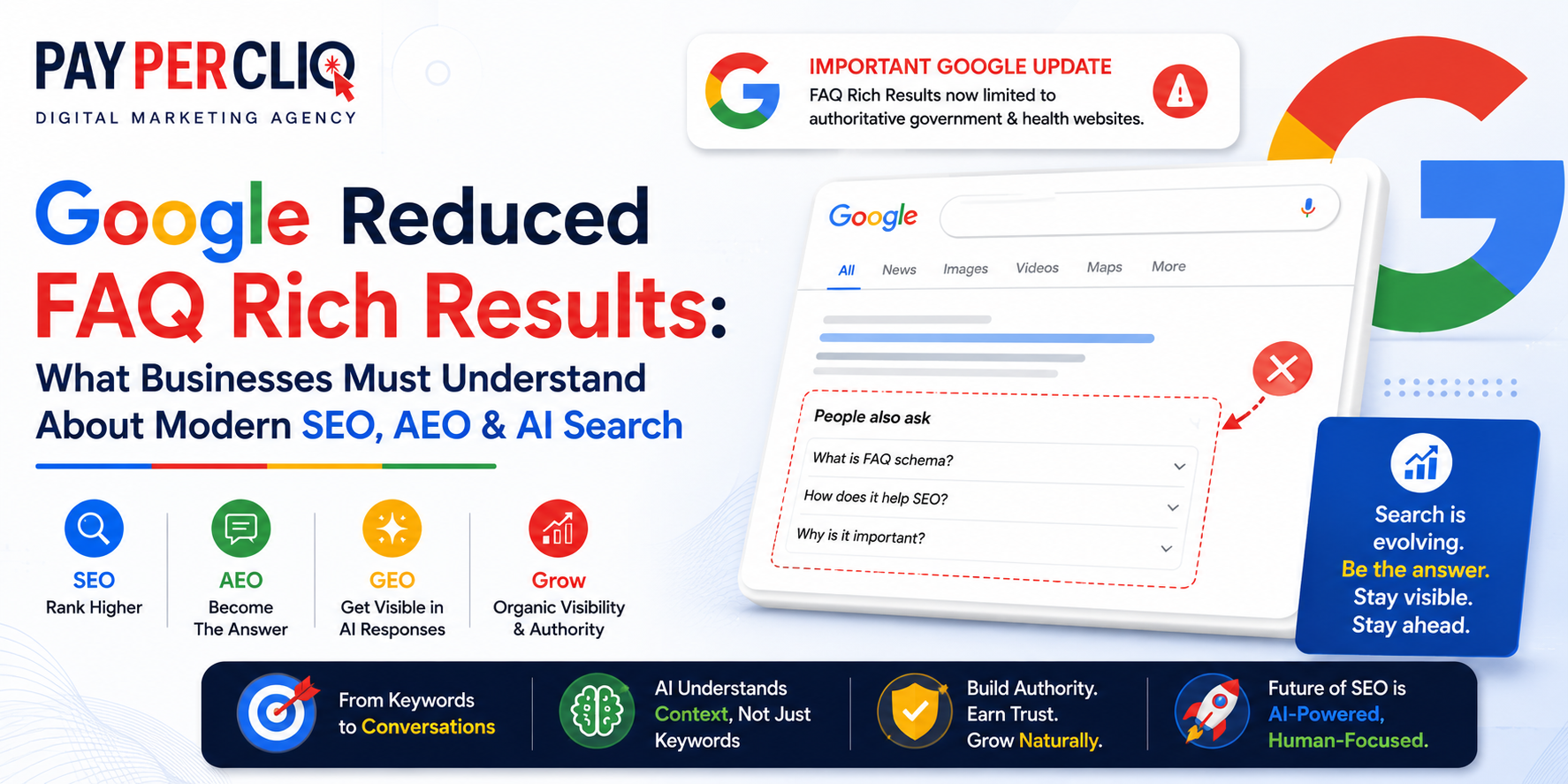
Google has quietly made one of the biggest changes in modern SEO — and surprisingly, many businesses still don’t fully understand its impact.
For years, FAQ schema was considered one of the easiest ways to increase visibility in Google Search. Websites added FAQ sections to blogs, service pages, product pages, and landing pages to earn rich snippets and occupy more space in SERPs.
But Google has now officially reduced FAQ rich result visibility for most websites.
At first glance, many businesses assumed:
“FAQ schema is dead.”
But the reality is completely different.
In fact, FAQ content has become even more important in the era of:
- Google AI Overview,
- ChatGPT,
- Gemini,
- Perplexity,
- conversational search,
- and AI-driven answer engines.
This shift is not the end of FAQ optimization.
It’s the beginning of a new phase of SEO — where search engines understand context, entities, trust, and conversational relevance more deeply than ever before.
What Exactly Did Google Change?
Google officially announced that FAQ rich results would now primarily be shown only for authoritative government and health websites.
You can read the official updates here:
Google Search Central Update on FAQ & HowTo Rich Results
Search Engine Journal Coverage on Google FAQ Rich Result Changes
Previously, businesses across industries heavily relied on FAQ schema because it helped:
- increase SERP visibility,
- improve CTR,
- dominate search results,
- add extra real estate in Google Search.
However, over time, Google noticed:
- excessive FAQ spam,
- low-quality repetitive answers,
- irrelevant schema usage,
- poor user experience.
As a result, Google significantly reduced FAQ rich snippet visibility.
This means:
Even if your FAQ schema is implemented correctly, Google may no longer display FAQ dropdowns in search results.
Does This Mean FAQ Schema Is No Longer Useful?
Absolutely not.
This is where most businesses misunderstand the update.
Google reduced the visual display of FAQ snippets — not the importance of FAQ content itself.
Search engines and AI systems still use FAQ content to:
- understand website context,
- analyze topical depth,
- process conversational queries,
- identify expertise,
- improve semantic understanding.
Modern search engines are moving beyond simple keyword matching.
Today, Google and AI models analyze:
- intent,
- entities,
- topical authority,
- conversational relevance,
- trust signals,
- structured information.
This is why FAQ sections continue to play a major role in:
- SEO,
- AEO (Answer Engine Optimization),
- GEO (Generative Engine Optimization),
- AI SEO,
- conversational search optimization.
The Evolution of SEO: From Rankings to Answers
Traditional SEO focused heavily on:
- keywords,
- backlinks,
- rankings,
- technical optimization,
- SERP manipulation.
But search behavior has changed dramatically.
Users now ask conversational questions like:
- “Which is the best SEO agency in Varanasi?”
- “How do I improve visibility in AI Overview?”
- “Which digital marketing company is best for local SEO?”
- “How can I rank in ChatGPT recommendations?”
Search engines and AI tools now aim to directly answer these questions instead of only displaying blue links.
This is exactly why:
- AEO (Answer Engine Optimization)
- GEO (Generative Engine Optimization)
are becoming increasingly important.
What is AEO (Answer Engine Optimization)?
AEO focuses on optimizing content for answer engines like:
- Google AI Overview,
- ChatGPT,
- Gemini,
- Perplexity,
- voice assistants,
- conversational AI systems.
The goal is no longer just:
“Rank higher.”
The goal is:
“Become the answer.”
AEO strategies involve:
- conversational content,
- structured information,
- semantic relevance,
- topical authority,
- FAQ optimization,
- entity-based SEO.
What is GEO (Generative Engine Optimization)?
GEO stands for Generative Engine Optimization.
It focuses on improving visibility inside AI-generated responses.
Unlike traditional search engines, LLMs and AI systems generate summarized answers using:
- trusted sources,
- authoritative websites,
- structured content,
- semantic relationships,
- conversational relevance.
Businesses that optimize for GEO improve their chances of being referenced in:
- AI-generated summaries,
- conversational answers,
- recommendation engines,
- generative search experiences.
Why FAQ Sections Still Matter More Than Ever
Even though FAQ rich snippets have reduced, FAQ sections are still extremely valuable because they help AI systems understand:
- what your business does,
- which problems you solve,
- what users commonly ask,
- how your services are structured,
- what expertise you offer.
A strong FAQ section improves:
- semantic SEO,
- conversational optimization,
- long-tail keyword coverage,
- entity relevance,
- AI discoverability.
This is especially important because AI search systems process information differently than traditional search engines.
Instead of matching exact keywords, AI models understand:
- context,
- relationships,
- meaning,
- expertise,
- authority.
What Businesses Should Focus On Now
Instead of chasing outdated SEO hacks, businesses should now focus on:
- high-quality content,
- topical authority,
- conversational SEO,
- AI-friendly structure,
- helpful FAQ content,
- entity optimization,
- Local SEO,
- trust-building signals.
Modern SEO is no longer just about rankings.
It is about:
- visibility,
- discoverability,
- authority,
- and becoming the trusted source that AI systems reference.
Why Local Businesses Must Adapt Quickly
Local businesses are one of the biggest beneficiaries of modern SEO and AI search optimization.
Today, users search conversationally:
- “Best saree shop in Varanasi”
- “Top digital marketing agency near me”
- “Best dentist in Varanasi”
- “Affordable SEO company in Varanasi”
AI systems and Google AI Overview increasingly prioritize:
- strong local authority,
- optimized Google Business Profiles,
- entity consistency,
- conversational content,
- structured local pages,
- FAQ-based relevance.
Businesses ignoring these changes may slowly lose visibility to competitors who adapt faster.
The Future of SEO Is Multi-Layered
SEO is no longer just one thing.
Modern search optimization now includes:
- Technical SEO
- Local SEO
- AI SEO
- AEO
- GEO
- Content Authority
- Entity SEO
- Conversational Optimization
- LLM Visibility
Businesses that understand this shift early will gain a major competitive advantage over the next few years.
How Pay Per Cliq Helps Businesses Adapt to Modern SEO
At Pay Per Cliq, we help businesses optimize not only for Google rankings but also for modern AI-driven search ecosystems.
Our strategies focus on:
- SEO,
- Local SEO,
- AEO,
- GEO,
- AI Overview optimization,
- ChatGPT visibility,
- Perplexity optimization,
- conversational SEO,
- topical authority building.
If you are looking for the Best SEO Agency in Varanasi, our team helps businesses build long-term organic visibility across both traditional and AI-powered search platforms.
We have worked with businesses across:
- Varanasi,
- Mumbai,
- Noida,
- Canada,
- USA,
- Dubai,
- and multiple global markets.
Our SEO strategies are designed not only to improve rankings but also to improve discoverability across emerging AI ecosystems.
Final Thoughts
Google reducing FAQ rich results is not the end of FAQ optimization.
It’s simply the evolution of search.
The future belongs to businesses that:
- create helpful content,
- answer real user questions,
- build topical authority,
- optimize for AI-driven discovery,
- and adapt beyond traditional SEO.
Search is becoming more conversational, contextual, and AI-powered every day.
Businesses that evolve now will dominate the future of organic visibility.
Frequently Asked Questions
Google reduced FAQ rich results to improve search quality and reduce spammy or low-value FAQ implementations in SERPs.
Yes. FAQ schema still helps Google and AI systems understand structured conversational content even if rich snippets are shown less frequently.
AEO stands for Answer Engine Optimization. It focuses on optimizing content for AI-powered answer engines like ChatGPT, Gemini, and Google AI Overview.
GEO stands for Generative Engine Optimization. It helps businesses improve visibility in AI-generated search experiences and conversational AI platforms.
Absolutely. FAQ sections improve semantic relevance, conversational optimization, topical authority, and AI discoverability.
AI changes how search engines understand and display information. Search systems now prioritize expertise, trust, context, and conversational relevance.
Yes. Businesses can improve visibility in AI search systems through structured content, topical authority, semantic SEO, FAQ optimization, and conversational content.
AI SEO refers to optimizing websites and content for AI-powered search experiences such as Google AI Overview, ChatGPT, Gemini, and Perplexity.
Modern search engines and AI systems process natural language queries. Conversational content helps improve answer relevance and discoverability.
Pay Per Cliq helps businesses improve visibility across Google Search, AI Overview, ChatGPT, Gemini, Perplexity, and other AI-driven discovery systems using advanced SEO, AEO, GEO, and Local SEO strategies.
