
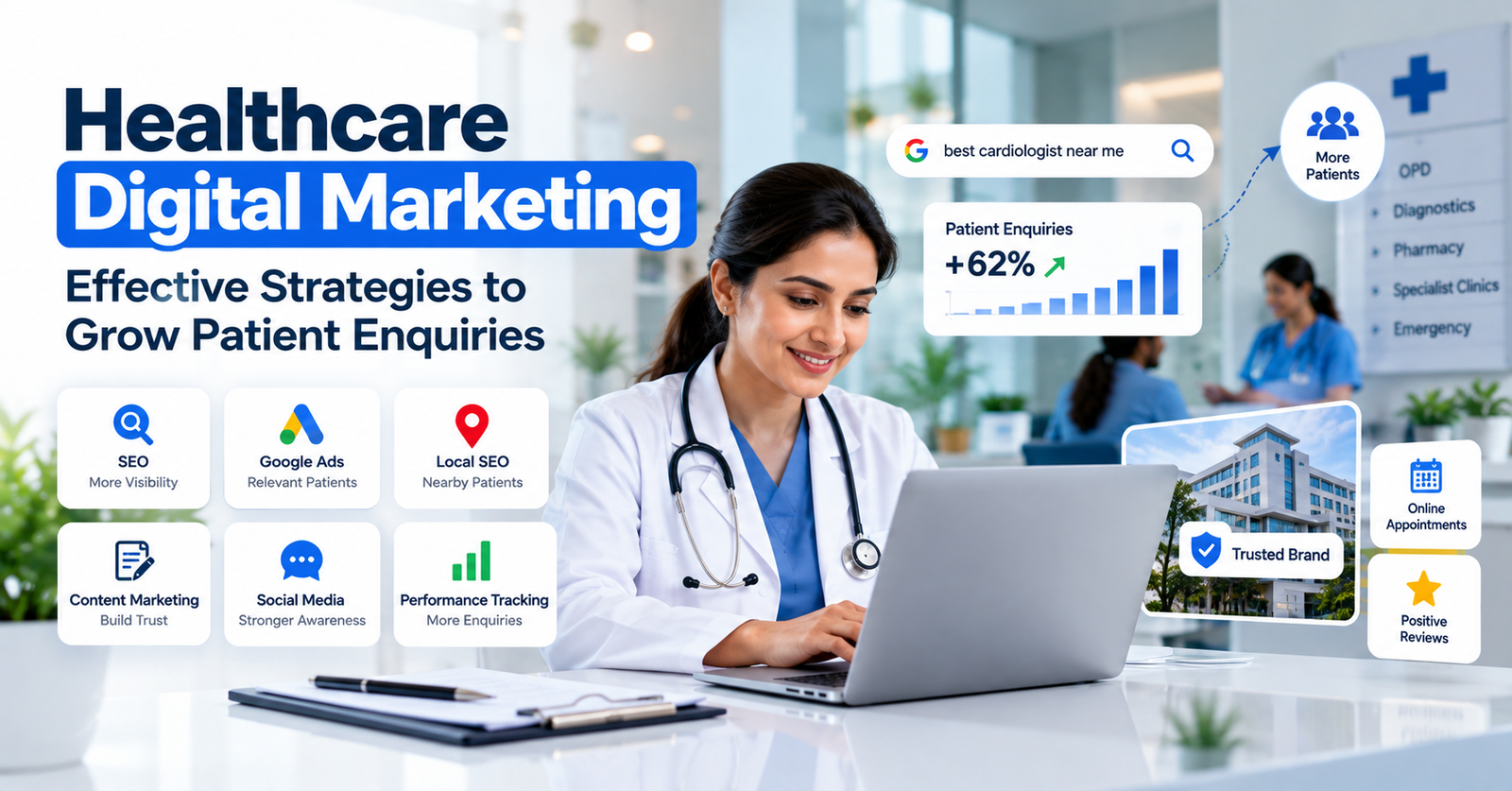
When someone needs a doctor, hospital or medical treatment, their search often begins online. They might look for a specialist nearby, compare hospitals, read patient reviews or visit a clinic’s website before making an appointment.
For healthcare providers, being visible at these moments matters. But getting more website visitors is not enough. The real goal is to help the right patients find relevant information, trust your healthcare facility and take the next step towards an appointment.
That is where healthcare digital marketing comes in. By combining search engine optimization (SEO), Google Ads, local search, useful content and a well-designed website, hospitals and clinics can improve their online presence and generate more relevant patient enquiries.
What Is Healthcare Digital Marketing?
Healthcare digital marketing is the use of online channels to help hospitals, doctors, clinics and other healthcare organizations reach people looking for medical services.
It includes improving visibility on Google, running relevant advertising campaigns, creating helpful medical content, managing online reputation and making it easier for patients to contact a healthcare provider.
Unlike many other industries, healthcare marketing requires additional care. Patients are often making important decisions about their health. Marketing communication should therefore be accurate, respectful, transparent and focused on helping people make informed choices.
1. Build Your Healthcare SEO Strategy Around Patient Searches
Search engine optimization helps your website appear when people search for medical services, treatments, specialists or hospitals.
However, an effective healthcare SEO strategy starts with understanding what potential patients are actually searching for.
For example, someone searching for “cardiologist near me” has a different need from someone searching for “what are the symptoms of heart disease?” The first person may be looking to book a consultation, while the second is looking for information.
Focus on service and specialty pages
Hospitals and clinics should have dedicated website pages for their important departments, specialties and services.
Depending on the services offered, these might include:
- Cardiology and heart care
- Orthopedics and joint replacement
- Gynecology and maternity care
- Dermatology and skin treatments
- Oncology and cancer care
- General and laparoscopic surgery
Each page should clearly explain the services available, who provides them, where the facility is located and how patients can enquire or book an appointment.
For larger hospitals, a well-organized website structure also helps Google understand the relationship between departments, treatments, doctors and locations.
Don’t ignore technical SEO
Even useful medical content can struggle to perform if the website is slow, difficult to navigate or has indexing problems.
Healthcare providers should regularly review mobile usability, page speed, broken links, important page indexing and website navigation.
Practical takeaway: Start by improving the pages most closely connected to appointments and patient enquiries, rather than publishing large numbers of unrelated blogs.
2. Improve Local Visibility Through Google Business Profile
For most clinics and hospitals, location plays a major role in how patients choose a healthcare provider.
Someone searching for a dentist, orthopedic doctor or diagnostic center may prefer a nearby option with clear contact details, directions and useful reviews.
A properly maintained Google Business Profile can help eligible healthcare facilities present accurate information in Google Search and Maps.
What should healthcare providers optimize?
- Correct business name, address and phone number
- Appropriate business categories
- Accurate opening hours and contact information
- Relevant medical services
- Genuine photographs of the facility
- A working website and appointment link, where applicable
- Professional responses to patient reviews
Business information should remain consistent across the website, Google Business Profile and other relevant online directories.
For healthcare organizations operating in multiple locations, each eligible location should have accurate, location-specific information rather than relying entirely on one generic page.
Practical takeaway: Check whether patients can quickly find your location, call your facility and understand which services are available before they visit.
3. Use Google Ads to Reach Patients Looking for Medical Services
SEO is important for building long-term search visibility, but Google Ads can help healthcare providers reach relevant audiences through paid search campaigns.
For example, a person searching for an orthopedic hospital in a particular city may be closer to making an appointment than someone reading general information about joint pain.
That difference in search intent should influence campaign planning.
Build campaigns around relevant medical services
Instead of sending all advertising traffic to a hospital homepage, consider dedicated campaigns and landing pages for individual specialties or services.
A hospital offering cardiology, orthopedics and maternity care may benefit from separate campaign structures because each service has different patient needs and search patterns.
Useful elements include:
- Relevant search keywords and location targeting
- Clear advertising messages without exaggerated claims
- Service-specific landing pages
- Easy-to-find appointment and enquiry options
- Appropriate conversion tracking
- Regular review of search terms and campaign performance
Healthcare advertisers must also follow applicable Google Ads healthcare policies, privacy requirements and local regulations. Some medical services, treatments and targeting methods are restricted.
Practical takeaway: Measure the quality of patient enquiries, not just clicks. A campaign generating fewer but more relevant enquiries may be more valuable than one producing large amounts of unqualified traffic.
4. Create a Website That Makes Appointment Enquiries Easier
Your website is often the next destination after a patient finds your hospital or clinic on Google.
If the website is confusing, slow or missing essential information, potential patients may leave without contacting you.
A healthcare website should make it easy to answer a few basic questions:
- Does this hospital or clinic provide the service I need?
- Which doctors or specialists are available?
- Where is the facility located?
- How can I book an appointment or request information?
- Can I understand the treatment or service in simple language?
Important conversion elements
Depending on the type of healthcare facility, useful website features may include a visible contact number, appointment request form, doctor profiles, location information, department navigation and a clear mobile experience.
Appointment forms should ask only for information necessary to respond to the enquiry. Sensitive medical details should be handled through appropriate secure systems rather than ordinary marketing forms.
Practical takeaway: Test your website on a mobile phone. If a new visitor cannot find the right service and contact option quickly, the patient journey needs improvement.
5. Build Patient Trust Through Useful Healthcare Content
Healthcare decisions involve trust. Patients want to understand their options, learn about the professionals providing care and feel confident that the information they are reading is reliable.
Helpful content can support this process.
For example, a hospital’s orthopedic department could publish articles explaining when someone should consult an orthopedic specialist, what to expect during a consultation or how different treatment options are generally evaluated.
Content should be written in language that ordinary readers can understand, without unnecessary medical jargon.
What makes healthcare content trustworthy?
- Clear, accurate explanations of medical topics
- Input or review from appropriately qualified healthcare professionals
- Author and medical reviewer information where relevant
- Updated information when medical guidance changes
- Balanced discussion of treatment options and limitations
- No unrealistic promises of treatment outcomes
Informational content should also distinguish general medical education from personalized medical advice.
From an SEO perspective, useful content helps establish the relevance of a hospital or clinic’s website to the services and specialties it genuinely offers.
Practical takeaway: Create content based on real patient questions, not simply keywords with high search volumes.
6. Use Social Media to Strengthen Healthcare Brand Awareness
Social media can help healthcare organizations communicate with their communities, introduce their medical teams and share useful health information.
It is particularly valuable for showing the human side of a hospital or clinic.
Relevant content may include:
- Doctor introductions and specialty information
- Educational health awareness videos
- Information about hospital departments and facilities
- Public health awareness campaigns
- Updates about services, timings and patient facilities
- Answers to common non-personal medical questions
Paid social media campaigns may also support awareness and appropriate service promotion, subject to platform advertising policies.
However, healthcare marketers should avoid implying knowledge of someone’s private medical condition or using sensitive patient information for advertising targeting.
Patient stories, photographs and testimonials require appropriate consent and must comply with applicable professional and privacy rules.
Practical takeaway: Use social media to educate and build familiarity with your healthcare organization, rather than treating every post as a direct sales advertisement.
7. Manage Online Reviews and Reputation Responsibly
Patients often read online reviews when researching hospitals, doctors and clinics.
Reviews can provide useful feedback about appointment processes, staff communication, facilities and the overall patient experience.
Healthcare providers should make it easy for patients to share genuine feedback without offering incentives or attempting to manipulate ratings.
When responding to reviews, maintain a professional tone and protect patient confidentiality. Avoid publicly confirming someone’s treatment, medical history or patient status.
Negative feedback should be handled respectfully, with an appropriate private channel for resolving concerns.
Practical takeaway: Treat online reputation management as part of patient experience improvement, not merely a strategy for collecting five-star ratings.
8. Optimize Healthcare Content for AI Search and Answer Engines
People now discover information through traditional search engines as well as AI-assisted search experiences.
For healthcare websites, the foundation of AI search optimization remains useful, trustworthy and accessible information.
Hospitals and clinics can improve the clarity of their online content by explaining medical services directly, organizing information into relevant sections and making professional credentials easy to verify.
Practical AI SEO improvements
- Answer common patient questions clearly and directly.
- Use descriptive headings that reflect the topic of each section.
- Provide accurate doctor, department and location information.
- Keep service details consistent across relevant website pages.
- Use appropriate structured data when supported by the page content.
- Publish original information that reflects the facility’s actual expertise and services.
Structured data can help search engines interpret website information, but it does not guarantee inclusion in AI-generated answers or special search features.
Likewise, simply repeating keywords or adding FAQ sections to every page is not an effective substitute for genuinely useful content.
Practical takeaway: Make your website easy for both people and search systems to understand, while keeping medical accuracy and patient trust at the center.
9. Measure Patient Enquiries, Not Just Website Traffic
One of the biggest mistakes in healthcare digital marketing is judging performance only by website visits, ad impressions or social media followers.
These numbers can help explain visibility, but they do not show whether marketing is bringing relevant enquiries.
A more useful performance review may include:
- Organic search visits to important service pages
- Calls and appointment requests from the website
- Enquiries generated by individual advertising campaigns
- Cost per relevant enquiry
- Appointment requests by specialty or service
- Landing page conversion rates
- Google Business Profile interactions
Where appropriate and legally permitted, healthcare organizations can also assess how enquiries progress into appointments using privacy-conscious reporting.
Advertising and analytics platforms should not receive sensitive patient information or protected medical details through improperly configured tracking systems.
Practical takeaway: Establish clear reporting before increasing marketing budgets. Understanding which channels produce relevant enquiries helps guide better decisions.
How Should Hospitals and Clinics Prioritize Digital Marketing?
Not every healthcare provider needs to invest in every marketing channel at the same time.
The right priorities depend on the organization’s services, location, competition, website condition and growth objectives.
| Business objective | Marketing priority |
|---|---|
| Improve local patient discovery | Local SEO, Google Business Profile and location pages |
| Generate relevant enquiries for specific services | Google Ads and service-specific landing pages |
| Build long-term organic visibility | SEO, specialty pages and medically reviewed content |
| Improve website enquiry rates | Website usability and conversion optimization |
| Increase awareness and trust | Educational content, social media and reputation management |
| Improve marketing efficiency | Conversion tracking, reporting and campaign optimization |
A smaller clinic may begin with local SEO, a strong service page and a focused Google Ads campaign. A multispecialty hospital may need a broader strategy covering multiple departments, specialists, locations and advertising campaigns.
The key is to prioritize channels based on patient demand and business goals rather than adopting every marketing trend.
Choosing the Right Healthcare Digital Marketing Agency
Healthcare marketing requires more than running advertisements or publishing blog posts. An agency should understand how patients search for medical services, how healthcare websites are structured and why trust matters throughout the patient journey.
When evaluating an agency, ask how it approaches healthcare SEO, specialty-specific campaigns, landing page performance, reporting, medical content accuracy and advertising compliance.
It is also worth understanding how the agency measures relevant enquiries and whether its recommendations match your hospital’s or clinic’s actual services.
PayPerCliq, a digital marketing agency in Varanasi, works with businesses across industries, including healthcare. Our approach combines search visibility, paid advertising, website optimization and performance measurement to support practical marketing objectives.
For hospitals, clinics and healthcare organizations looking for a more focused approach, explore our healthcare digital marketing services.
We also provide specialized solutions for hospital digital marketing and digital marketing for doctors and medical practices.
Frequently Asked Questions About Healthcare Digital Marketing
What is the best digital marketing strategy for a hospital?
There is no single strategy that works for every hospital. A practical approach often combines specialty-specific SEO, local search optimization, relevant Google Ads campaigns, helpful medical content and a website that makes patient enquiries easy.
How can digital marketing help clinics get more patient enquiries?
Digital marketing helps clinics become more visible when people search for relevant medical services. Local SEO, search advertising and clear appointment options can help turn that visibility into enquiries from potential patients.
Is SEO or Google Ads better for healthcare marketing?
SEO supports long-term organic visibility, while Google Ads can provide paid visibility for relevant searches. Many healthcare organizations benefit from using both, with budgets and priorities based on their goals and competition.
How long does healthcare SEO take to show results?
SEO timelines vary according to website condition, competition, location and the quality of existing content. Some technical or local visibility improvements may be noticed sooner, while competitive organic rankings often require sustained work over several months.
How do you measure the success of healthcare digital marketing?
Useful measures include relevant website traffic, appointment enquiries, calls, landing page conversion rates and cost per qualified enquiry. Healthcare organizations should use privacy-conscious tracking and avoid sharing sensitive patient information with advertising platforms.
Final Thoughts
Effective healthcare digital marketing is not about attracting the highest possible number of visitors. It is about helping the right people discover your medical services, find trustworthy information and contact your facility when they need care.
Start with the essentials: relevant service pages, strong local visibility, a useful website, accurate healthcare content and measurable marketing campaigns. Build from there based on actual patient enquiries and business priorities.
If your hospital or clinic needs a structured strategy, explore PayPerCliq’s healthcare digital marketing services or contact our team on WhatsApp to discuss your requirements.
