
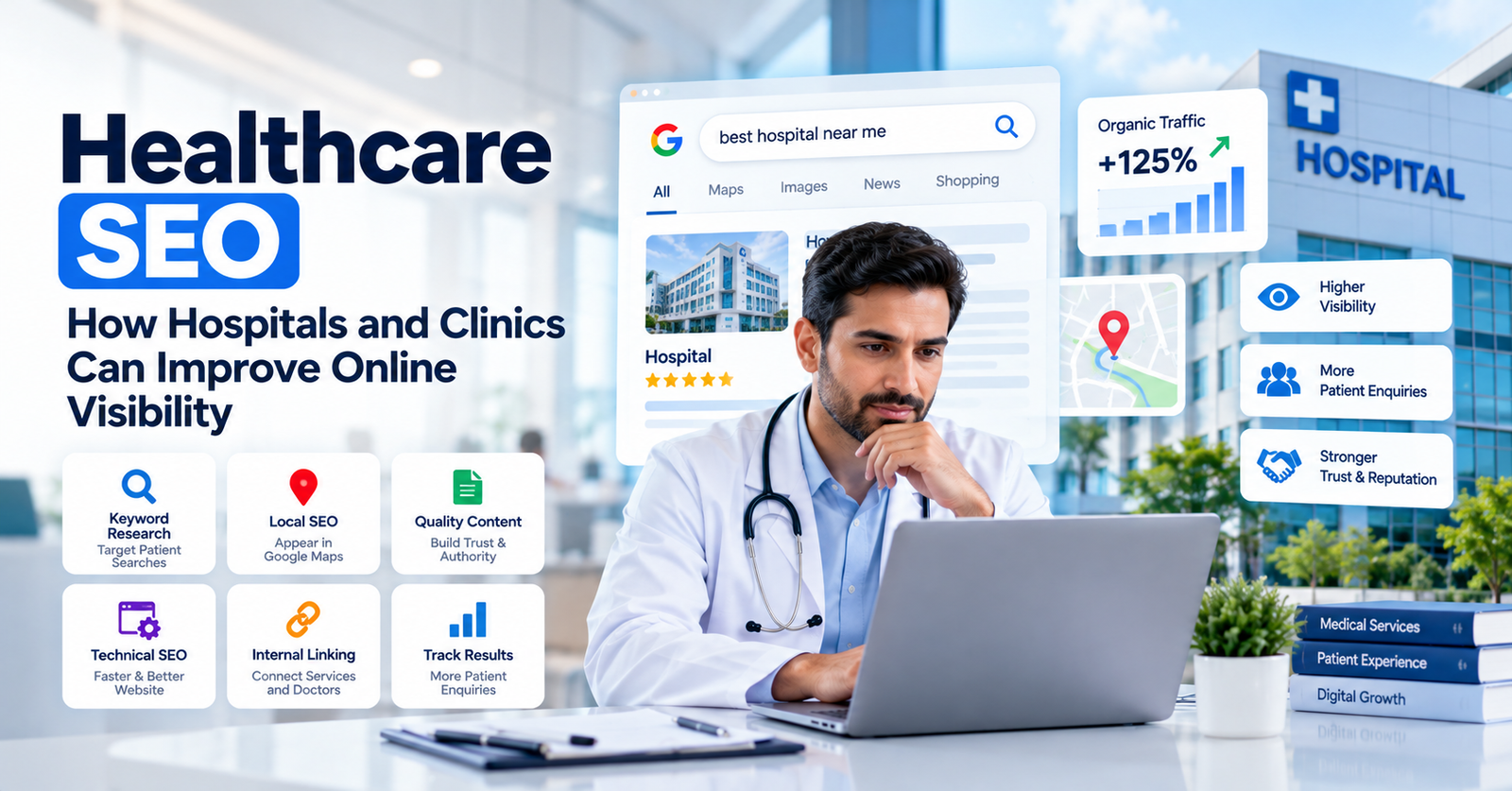
When someone searches for a hospital, specialist or medical service on Google, they usually want useful information quickly. They may be looking for a nearby clinic, comparing treatment facilities or checking whether a particular doctor is available.
If your hospital or clinic does not appear for relevant searches, potential patients may never discover your services.
This is where healthcare SEO becomes important. It helps medical websites improve their visibility in search results, reach people looking for relevant services and make it easier for patients to find accurate information before contacting a healthcare provider.
However, healthcare SEO is not simply about adding keywords to website pages. It requires a clear website structure, useful medical content, accurate local information and a good user experience.
What Is Healthcare SEO?
Healthcare SEO (Search Engine Optimization) is the process of improving a hospital’s, doctor’s or clinic’s website so that it can appear more prominently in relevant organic search results.
For example, a hospital offering orthopedic services may want its orthopedic department page to appear when someone searches for an orthopedic hospital in its city.
Similarly, a dermatology clinic may want patients to find its website when searching for dermatologists or available skin treatments nearby.
Healthcare SEO generally includes:
- Keyword research based on patient search intent
- Optimization of medical service and specialty pages
- Local SEO and Google Business Profile optimization
- Technical website improvements
- Accurate, helpful healthcare content
- Internal linking and website navigation
- Organic search performance measurement
The objective is not to rank for every medical keyword. It is to become visible for searches that genuinely relate to the healthcare services your organization provides.
1. Understand How Patients Search for Healthcare Services
Before optimizing a healthcare website, understand the different reasons people search for medical information.
Not every search indicates that someone is ready to book an appointment.
Service-related searches
These searches often come from people looking for a healthcare provider or a specific medical service.
- Orthopedic hospital in Varanasi
- Dermatologist near me
- Cardiology hospital in Mumbai
- Gynecology clinic near me
Such searches are generally relevant to specialty pages, clinic pages and hospital location pages.
Informational searches
Other people search because they want to understand a symptom, condition, procedure or treatment.
For example:
- When should you consult an orthopedic doctor?
- What happens during a cardiology consultation?
- How is a knee replacement evaluated?
These searches are better served by accurate educational content that explains the topic without making unsupported medical claims.
SEO takeaway: Match each search intent to the appropriate page. A department page should help people understand and access a service, while an informational article should answer a specific question.
2. Create Dedicated Pages for Important Medical Specialties
One of the most common website structure problems is placing too many medical services on a single page.
For example, a multispecialty hospital may list cardiology, orthopedics, gynecology, oncology and general surgery on its homepage without providing enough information about any individual department.
This makes it harder for visitors to find relevant information and gives search engines less context about each specialty.
What should a medical specialty page include?
A useful specialty page should clearly explain:
- The medical department or service being offered
- The conditions or healthcare needs it addresses
- Available consultations, procedures or facilities
- Relevant doctors and their qualifications
- The hospital or clinic location
- How to contact the department or request an appointment
For example, an orthopedic department page should primarily focus on orthopedic services. It should not be filled with unrelated information about every department in the hospital.
Similarly, individual doctor profiles can provide useful information about qualifications, specialties, consultation availability and professional experience.
SEO takeaway: Create detailed, useful pages for your actual services instead of generating multiple nearly identical pages for minor keyword variations.
3. Optimize Page Titles, Headings and Website Content
On-page SEO helps search engines and visitors understand what each website page is about.
For healthcare websites, this means using clear language that reflects the services offered.
Write descriptive title tags
A title tag should communicate the page’s main topic and, where relevant, its location or healthcare brand.
For example:
Orthopedic Department in Varanasi | Hospital Name
This is generally more useful than a vague title such as “Best Healthcare Solutions” because it identifies the actual service.
Use headings logically
Each page should have a clear main heading, followed by sections that help readers navigate the information.
An orthopedic service page might use headings such as:
- Orthopedic Services Available
- Conditions Evaluated by Our Orthopedic Team
- Meet Our Orthopedic Specialists
- How to Book an Orthopedic Consultation
Write for patients, not just search engines
Avoid repeating phrases such as “best orthopedic hospital” throughout the content.
Instead, explain the services, facilities and relevant patient information naturally.
Healthcare content should be accurate, easy to understand and reviewed by appropriately qualified professionals when it contains medical guidance.
SEO takeaway: A well-optimized page should answer the visitor’s questions clearly without feeling like it was written only to target keywords.
4. Improve Local SEO for Hospitals and Clinics
Local SEO is particularly important for healthcare facilities because patients often search for medical services within a specific city or nearby area.
Google may display a local map pack for searches such as “dentist near me” or “hospital in Varanasi.”
Visibility in these results depends on several factors, including relevance, distance and prominence. No agency can guarantee a particular Google Maps ranking.
Optimize your Google Business Profile
Eligible hospitals and clinics should maintain accurate Google Business Profile information, including:
- Official business name
- Correct address and phone number
- Relevant business category
- Accurate operating hours
- Website and appointment information
- Available services
- Genuine facility photographs
Doctors and healthcare facilities should also follow Google’s eligibility and practitioner-profile guidelines rather than creating unnecessary duplicate listings.
Keep location details consistent
Your website should display the same essential contact and location information as your Google Business Profile.
If a hospital operates multiple eligible locations, each location should have useful, accurate information on the website.
A location page can include the address, directions, contact details, services available at that branch and appointment information.
SEO takeaway: Make it easy for both Google and potential patients to understand where your healthcare facility operates and what services are available there.
5. Fix Technical SEO Problems That Affect Website Visibility
Even a well-written healthcare website can struggle in organic search if important pages cannot be crawled or indexed properly.
Technical SEO focuses on making the website accessible, organized and usable.
Important technical SEO checks
- Indexing: Confirm that important service pages are eligible to appear in Google Search.
- Mobile usability: Ensure pages work properly on smartphones.
- Website speed: Optimize heavy images, unnecessary scripts and slow-loading elements.
- Internal links: Connect related departments, services and doctor profiles logically.
- Canonical URLs: Avoid confusing search engines with unnecessary duplicate page versions.
- XML sitemap: Help search engines discover important website URLs.
- Structured data: Use relevant, valid schema markup where it accurately describes visible page information.
- HTTPS: Keep the website secure and protect information submitted through forms.
For healthcare organizations, technical improvements should also support accessibility and a reliable patient experience.
SEO takeaway: Before publishing more content, make sure Google can access and understand the pages that already exist.
6. Build Trust Through Accurate Medical Content
Medical information can influence decisions about health and treatment. Search engines therefore place particular importance on signals associated with helpfulness, reliability and trustworthiness for health-related topics.
Healthcare organizations should approach content creation with medical accuracy as the first priority.
How to improve healthcare content quality
- Explain medical topics using clear, understandable language.
- Use qualified medical authors or reviewers for clinical information.
- Display relevant professional credentials where appropriate.
- Update content when medical guidance or services change.
- Avoid unsupported claims about treatments or outcomes.
- Clearly distinguish general information from personalized medical advice.
- Provide accurate information about the healthcare services actually available.
For example, a blog explaining a medical procedure should help patients understand the general process, possible considerations and questions to discuss with a qualified clinician.
It should not promise specific results or imply that every patient will have the same experience.
SEO takeaway: Publish fewer, better medical articles rather than large volumes of generic content that add little value.
7. Use Internal Linking to Connect Departments, Doctors and Educational Content
Internal links help visitors move between related pages and help search engines understand how website topics are connected.
For a healthcare website, useful internal linking might look like this:
- An orthopedic department page links to relevant orthopedic doctor profiles.
- A doctor profile links to the department where the doctor practices.
- An educational article about joint replacement links to the relevant orthopedic service page.
- A hospital location page links to departments available at that location.
These links should be useful to the reader and reflect genuine relationships between services and content.
Avoid placing links to unrelated departments simply to increase the number of internal links.
SEO takeaway: Build a website structure that helps patients find the right medical information and appointment options with fewer steps.
8. Optimize for AI Search Without Ignoring Traditional SEO
Search is evolving as people use AI-assisted tools to ask questions and compare information.
For healthcare websites, this creates another reason to make information clear, accurate and easy to interpret.
There is no separate technique that guarantees a hospital will appear in AI-generated answers. However, several good SEO practices can improve the overall quality and accessibility of content.
Useful AI-search optimization practices
- Answer important questions directly.
- Use descriptive headings for individual topics.
- Keep doctor, specialty and location information accurate.
- Explain medical terminology in plain language.
- Provide original details about the facility and its actual services.
- Use appropriate structured data without adding misleading information.
- Maintain consistent business information across relevant online sources.
For example, a department page should make it easy to identify which medical services are offered, who provides them and where patients can access them.
This is more useful than filling the page with repeated keywords or artificial question-and-answer sections.
SEO takeaway: Strong AI-search readiness starts with trustworthy information and a technically accessible website.
9. Track Healthcare SEO Performance Using the Right Metrics
SEO performance should be measured against the hospital’s or clinic’s actual objectives.
Ranking improvements can be useful, but they do not automatically mean that a website is attracting relevant patient enquiries.
Healthcare organizations should review metrics such as:
- Organic clicks and impressions in Google Search Console
- Visibility for relevant service and specialty searches
- Organic traffic to important department pages
- Website calls and appointment enquiries
- Organic landing page conversion rates
- Google Business Profile interactions
- Technical indexing and website performance issues
Google Search Console helps identify which search queries and pages generate organic visibility, while properly configured website analytics can help evaluate user journeys and enquiry actions.
Healthcare tracking must respect patient privacy. Sensitive medical information should not be sent to advertising or analytics platforms through ordinary tracking configurations.
SEO takeaway: Focus on whether organic search is bringing relevant visitors to the right pages and helping them take meaningful next steps.
Healthcare SEO Checklist for Hospitals and Clinics
Use this checklist to review the fundamentals of your healthcare website.
- Identify your most important medical services and specialties.
- Create dedicated, useful pages for those services.
- Write clear page titles, headings and descriptions.
- Ensure important pages can be indexed by Google.
- Improve mobile usability and website loading performance.
- Maintain accurate Google Business Profile information.
- Connect relevant service, doctor and educational pages.
- Review medical content for accuracy and clarity.
- Use appropriate structured data where applicable.
- Track organic search visibility and relevant enquiries.
Hospitals with several departments may need a larger SEO plan, while smaller clinics can begin by improving their most important service and location pages.
Should You Hire a Healthcare SEO Agency?
Healthcare SEO can involve several types of work, from technical website improvements to specialty-specific content and local search optimization.
For hospitals managing multiple departments, doctors and locations, coordinating these activities can become challenging.
A healthcare-focused digital marketing partner should understand medical search intent, website architecture, local SEO, content accuracy and how organic visibility connects to relevant patient enquiries.
At PayPerCliq, a digital marketing agency in Varanasi, we work with healthcare organizations and other businesses on search visibility, paid advertising, website optimization and performance-focused digital strategies.
Our healthcare digital marketing services combine SEO with other relevant channels to support hospitals, clinics and medical practices.
For more specialized requirements, explore our hospital digital marketing services and digital marketing services for doctors.
You can also read our related guide, Healthcare Digital Marketing: Effective Strategies to Grow Patient Enquiries, for a broader look at SEO, paid advertising, content and patient enquiry generation.
Frequently Asked Questions About Healthcare SEO
What is healthcare SEO?
Healthcare SEO is the process of improving a hospital’s, clinic’s or medical practice’s website so it can become more visible for relevant organic searches on Google and other search engines.
Why is SEO important for hospitals?
SEO helps hospitals make their departments, medical services, doctor information and locations easier to discover when people search for relevant healthcare services online.
How is healthcare SEO different from regular SEO?
Healthcare SEO uses many standard SEO techniques, but medical content requires particular attention to accuracy, professional expertise, patient trust and privacy. Healthcare websites also commonly need specialty pages, doctor profiles and location-specific information.
How long does healthcare SEO take?
The timeline depends on the website’s condition, competition, location and existing visibility. Some improvements may be noticeable sooner, but competitive organic search growth usually requires ongoing optimization over several months.
Can local SEO help a small clinic?
Yes. Local SEO can help eligible clinics improve how they present their services and location information in relevant local searches. Accurate business details, useful service pages and a properly maintained Google Business Profile are important starting points.
Conclusion
Healthcare SEO works best when it helps patients find reliable information about the medical services they actually need.
For hospitals and clinics, the priorities are straightforward: build useful specialty pages, improve local visibility, fix technical website issues, publish accurate medical content and measure relevant enquiries.
Rather than chasing every keyword, focus on the searches that connect directly to your services and locations.
If you want to improve your healthcare website’s organic visibility, explore PayPerCliq’s healthcare digital marketing solutions or contact our team on WhatsApp to discuss your SEO requirements.
