
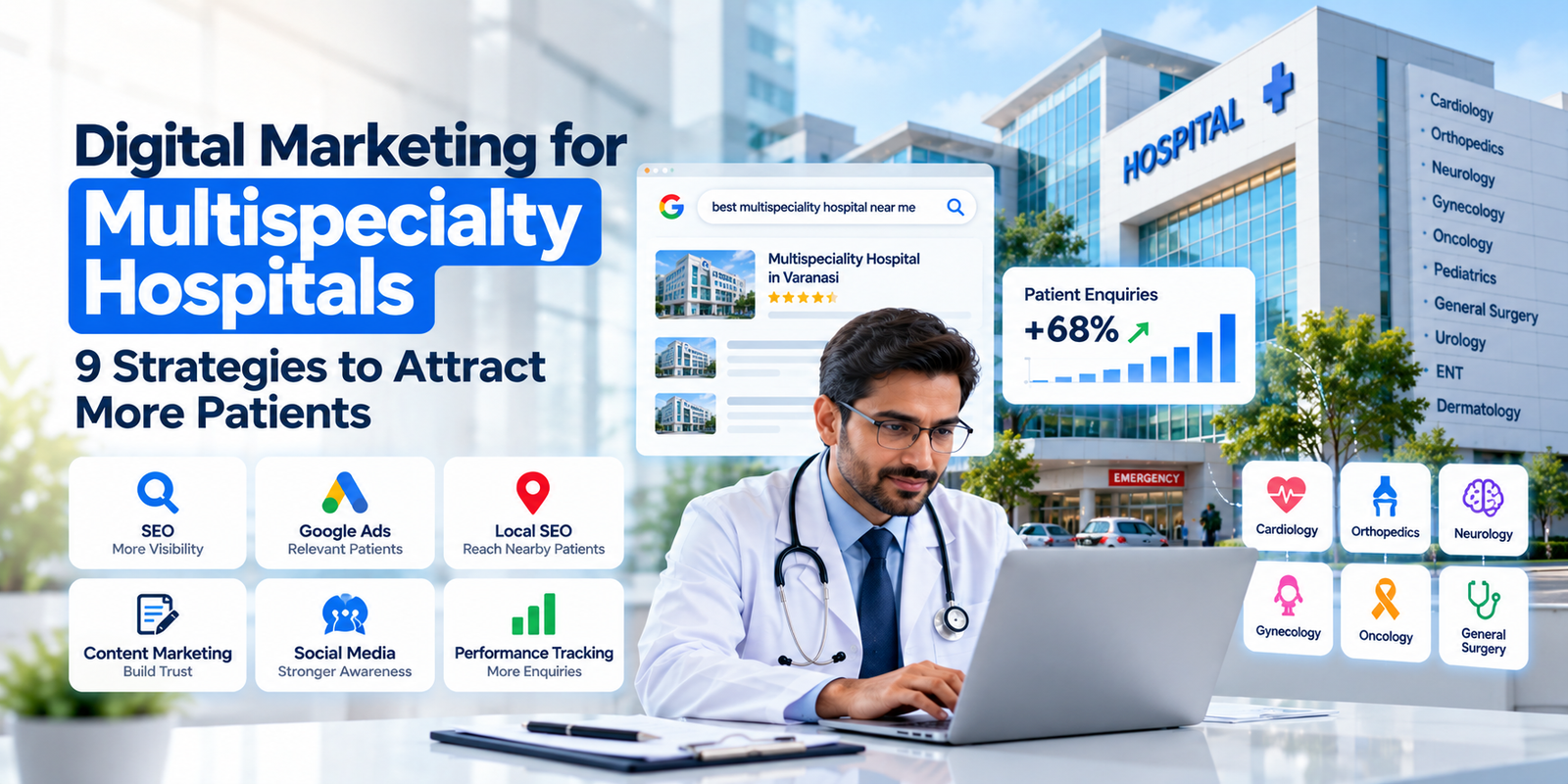
Marketing a multispecialty hospital is different from promoting a single-specialty clinic. A hospital may offer cardiology, orthopedics, neurology, gynecology, oncology, general surgery and several other services, each serving patients with different needs.
Someone searching for a cardiologist may not be interested in the hospital’s maternity services. Similarly, a patient looking for knee replacement treatment needs different information from someone searching for a neurologist.
That is why digital marketing for multispecialty hospitals needs a department-focused approach rather than one generic campaign for the entire hospital.
A practical strategy combines search engine optimization (SEO), Google Ads, local search, patient-focused content, website improvements and performance tracking to help people discover the right department and make an enquiry.
What Is Digital Marketing for Multispecialty Hospitals?
Digital marketing for multispecialty hospitals involves promoting a hospital’s medical departments, specialists, facilities and services through relevant online channels.
Its purpose is to make the hospital easier to discover when people search for healthcare services, provide useful information about available care and simplify the process of contacting the appropriate department.
Unlike marketing a single medical practice, multispecialty hospital marketing often involves coordinating multiple service lines under one hospital brand.
For example, the marketing requirements of an orthopedic department may differ from those of cardiology or maternity care. Each department may need its own SEO pages, advertising campaigns, content and enquiry tracking.
1. Develop a Department-Wise Digital Marketing Strategy
One of the biggest mistakes hospitals make is promoting every department through the same advertising campaigns and landing pages.
Although brand awareness campaigns have their place, patients searching for specific medical services generally need information about the relevant department.
A better approach is to identify the hospital’s priority departments and build a marketing strategy around each one.
How to prioritize departments
Hospital management and marketing teams can evaluate departments based on:
- Availability of doctors and medical facilities
- Local demand for relevant services
- Existing patient enquiry patterns
- Competition from other healthcare providers
- Department capacity and appointment availability
- The hospital’s growth objectives
For example, a hospital looking to expand its orthopedic services may prioritize orthopedic SEO, relevant Google Ads campaigns and a dedicated department landing page.
Meanwhile, departments with established demand may benefit more from website improvements and local search optimization.
Practical recommendation: Create a department-wise marketing plan rather than distributing the same budget and effort across every specialty.
2. Build Dedicated SEO Pages for Every Major Department
Search engine optimization helps hospitals improve their visibility when people search for medical services, specialists and treatment facilities.
However, a hospital homepage cannot effectively answer every specialty-specific search.
A multispecialty hospital should have dedicated pages for its major departments, provided those services are genuinely available.
Example hospital website structure
- Homepage – Hospital overview and primary information
- Cardiology – Cardiac services and specialists
- Orthopedics – Bone, joint and orthopedic care
- Neurology – Neurological consultations and services
- Gynecology – Women’s healthcare services
- Oncology – Cancer care services
- Doctor Profiles – Qualifications and consultation information
- Contact and Appointments – Enquiry and booking options
Each department page should clearly describe its services, available facilities, relevant doctors, location and appointment process.
Page titles and headings should reflect what patients are searching for without using exaggerated claims such as “best hospital” unless such claims are appropriately substantiated.
For more detailed guidance on website optimization, read our article on healthcare SEO for hospitals and clinics.
Practical recommendation: Start by improving the hospital’s most important department pages before publishing large numbers of unrelated blog posts.
3. Run Specialty-Specific Google Ads Campaigns
Google Ads can help hospitals reach people actively searching for relevant healthcare services.
But the success of a campaign depends heavily on search intent, location targeting, advertising policies and the quality of the landing page.
For a multispecialty hospital, separate campaigns or carefully structured ad groups can help organize advertising around individual departments.
Example campaign structure
| Department | Campaign focus | Landing page |
|---|---|---|
| Cardiology | Relevant cardiology and cardiac consultation searches | Cardiology department page |
| Orthopedics | Orthopedic specialists and available services | Orthopedic department page |
| Gynecology | Gynecology consultations and maternity services | Gynecology department page |
| Neurology | Neurology specialists and consultations | Neurology department page |
This structure makes it easier to align the advertisement with the patient’s search and the information available on the destination page.
For example, someone searching for an orthopedic consultation should ideally reach a page about orthopedic services, not a generic hospital homepage.
Hospitals must also comply with Google Ads healthcare policies, applicable medical advertising regulations and patient privacy requirements. Certain treatments and advertising approaches may be restricted.
Practical recommendation: Measure relevant appointment enquiries by department rather than evaluating every campaign only through clicks and impressions.
4. Strengthen Local SEO and Google Maps Visibility
Many patients look for hospitals and specialists within a particular city or nearby area.
Searches such as “multispecialty hospital near me” or “orthopedic hospital in Varanasi” indicate that location is an important part of the patient’s decision.
Local SEO helps eligible hospitals present accurate business and location information in Google Search and Maps.
Important local SEO activities
- Maintain accurate Google Business Profile details.
- Choose relevant business categories.
- Keep contact numbers and operating hours updated.
- Add genuine photographs of the hospital and its facilities.
- Maintain consistent address information across the website.
- Provide useful location and directions information.
- Respond professionally to genuine reviews without disclosing patient information.
For hospital groups operating at multiple locations, each eligible facility should have accurate, location-specific information.
Avoid creating unnecessary duplicate listings or separate business profiles for departments that do not meet Google’s eligibility requirements.
Practical recommendation: Check whether a new patient can find your hospital, identify its available services and contact the correct location without confusion.
5. Optimize the Hospital Website for Patient Enquiries
A hospital website may attract relevant visitors through SEO or advertising, but those visits are less useful if patients cannot find the information they need.
Hospital websites often contain several departments, doctor profiles and service pages. Navigation should help visitors reach the appropriate section quickly.
Essential website features
- Clear navigation for departments and specialties
- Updated doctor profiles and consultation information
- Visible contact and appointment options
- Mobile-friendly pages
- Accurate hospital location details
- Fast-loading pages
- Accessible and understandable content
- Secure and appropriate enquiry forms
For example, a visitor arriving on the cardiology page should be able to identify the available specialists and find the relevant appointment option without navigating through several unrelated pages.
Hospitals should also avoid collecting unnecessary sensitive medical information through ordinary marketing enquiry forms.
Practical recommendation: Test the appointment journey separately for every major department, particularly on mobile devices.
6. Create Medical Content That Answers Real Patient Questions
Patients frequently research healthcare topics before choosing a hospital or specialist.
Useful medical content can help hospitals explain their services, answer common questions and provide information that supports informed healthcare decisions.
For example, an orthopedic department may publish educational content about when to consult an orthopedic specialist or what to expect during an initial consultation.
A maternity department may explain the general stages of prenatal care and the services available at the hospital.
How to organize hospital content
Instead of publishing unrelated articles, connect educational content to the relevant medical department.
For example:
- Orthopedic articles link to the orthopedic department.
- Cardiology articles link to cardiology services and relevant specialists.
- Women’s health articles link to gynecology or maternity services.
- Doctor profiles link to the departments where those doctors practice.
Medical information should be accurate, written or reviewed by appropriately qualified professionals and updated when relevant guidance changes.
Content should not promise treatment outcomes or replace personalized medical advice.
Practical recommendation: Build educational content around genuine patient questions and the medical services the hospital actually offers.
7. Use Social Media to Communicate the Hospital’s Expertise
Social media provides an opportunity to introduce the hospital’s medical teams, share educational information and communicate updates about available services.
For a multispecialty hospital, content can be planned across departments while maintaining one consistent hospital identity.
Useful hospital social media content
- Doctor introductions and professional credentials
- Department and facility information
- General health awareness videos
- Educational explanations from qualified specialists
- Hospital service updates
- Community health initiatives
Rather than turning every post into a promotional advertisement, focus on information that patients and families may find genuinely helpful.
Patient testimonials, photographs and treatment stories require appropriate consent and must comply with applicable privacy and professional requirements.
Practical recommendation: Develop a monthly content calendar that represents priority departments without overwhelming audiences with repetitive promotional messages.
8. Improve Online Reputation and Patient Communication
Online reputation is an important consideration for hospitals because patients and families may review public feedback before contacting a healthcare facility.
However, reputation management should focus on genuine patient experience and professional communication, not simply increasing star ratings.
Hospitals can improve their approach by:
- Monitoring feedback across relevant platforms
- Encouraging genuine, voluntary reviews without incentives
- Responding respectfully to concerns
- Protecting patient confidentiality in public replies
- Sharing recurring feedback with the appropriate hospital teams
For multispecialty hospitals, feedback may relate to appointment scheduling, reception processes, facilities or communication across different departments.
Identifying recurring issues can help management improve the patient experience.
Practical recommendation: Treat reputation management as a joint responsibility between marketing, administration and patient experience teams.
9. Track Enquiries and Marketing Performance by Department
One of the most valuable improvements a multispecialty hospital can make is separating marketing performance by service line.
If all website enquiries and advertising results are combined into one report, hospital management may struggle to understand which departments are generating relevant interest.
A department-wise reporting approach provides clearer information.
Important marketing metrics
- Organic traffic to individual department pages
- Google Ads enquiries by specialty
- Relevant calls and appointment requests
- Landing page conversion rates
- Cost per relevant enquiry
- Local search interactions
- Website technical and search visibility trends
Where appropriate and legally permitted, hospitals may also evaluate how enquiries progress into scheduled appointments using privacy-conscious reporting processes.
Marketing analytics should not expose sensitive patient or medical information to advertising platforms.
Practical recommendation: Review marketing performance by department and channel before deciding where to increase or reduce budgets.
How to Allocate Digital Marketing Budgets Across Hospital Departments
There is no fixed percentage of marketing budget that every multispecialty hospital should assign to SEO, Google Ads or social media.
Budget allocation should reflect the hospital’s services, existing demand, competition and available capacity.
| Situation | Recommended priority |
|---|---|
| Newly introduced specialty | Department landing page, local visibility and relevant awareness campaigns |
| High-demand specialty with strong competition | SEO improvements, targeted search advertising and conversion optimization |
| Established department with low website enquiries | Website usability, search intent analysis and enquiry journey improvements |
| Hospital opening a new location | Location pages, eligible Google Business Profile setup and local campaigns |
| Limited overall marketing budget | Prioritize a few departments with clear demand and measurable objectives |
A hospital should avoid dividing its budget equally across departments simply because they all exist. Marketing investment should follow clear priorities and be reviewed against actual performance.
Why Multispecialty Hospitals Need a Specialized Marketing Approach
Hospital marketing involves coordinating multiple departments, medical professionals, patient needs and communication channels.
A general advertising approach may generate website traffic, but it can overlook important differences between specialty searches and patient enquiry journeys.
Working with a team familiar with healthcare marketing can help hospitals organize department-wise SEO, relevant advertising campaigns, landing pages and performance reporting.
PayPerCliq is a digital marketing agency in Varanasi with experience working across healthcare and other industries.
Our approach focuses on connecting relevant search demand with clear website experiences and measurable marketing objectives.
Explore our hospital digital marketing services for multispecialty and superspecialty hospitals.
We also offer broader healthcare digital marketing solutions and digital marketing services for doctors.
Frequently Asked Questions
What is the best digital marketing strategy for a multispecialty hospital?
A department-wise strategy is generally a practical starting point. It combines relevant SEO pages, specialty-specific advertising, local search visibility, useful medical content and enquiry tracking based on each department’s needs.
How can multispecialty hospitals generate more patient enquiries online?
Hospitals can improve relevant enquiries by making their departments easier to discover through Google Search, maintaining accurate local information, running appropriate search campaigns and simplifying website appointment journeys.
Should every hospital department have a separate website?
Usually, separate websites are unnecessary. Dedicated department pages within one well-organized hospital website are often easier to maintain and provide a consistent experience for patients. Separate websites may be appropriate in particular organizational circumstances.
Are Google Ads effective for multispecialty hospitals?
Google Ads can be useful for reaching people searching for relevant hospital services. Campaign effectiveness depends on targeting, competition, landing page quality, compliance and how relevant enquiries are measured.
How should hospitals measure digital marketing success?
Hospitals should evaluate relevant appointment enquiries, organic visibility, campaign performance, landing page conversion rates and cost per relevant enquiry. Department-wise reporting provides additional insight into which services benefit from each marketing channel.
Conclusion
Effective digital marketing for multispecialty hospitals begins with understanding that each department serves a different patient need.
Instead of relying entirely on generic hospital promotions, build useful specialty pages, run relevant campaigns, improve local visibility and measure enquiries at the department level.
This creates a more organized marketing approach and helps hospital management make better decisions about its digital investments.
If your hospital is looking to improve online visibility and generate more relevant enquiries, explore PayPerCliq’s hospital digital marketing services or contact our team to discuss your requirements.
