
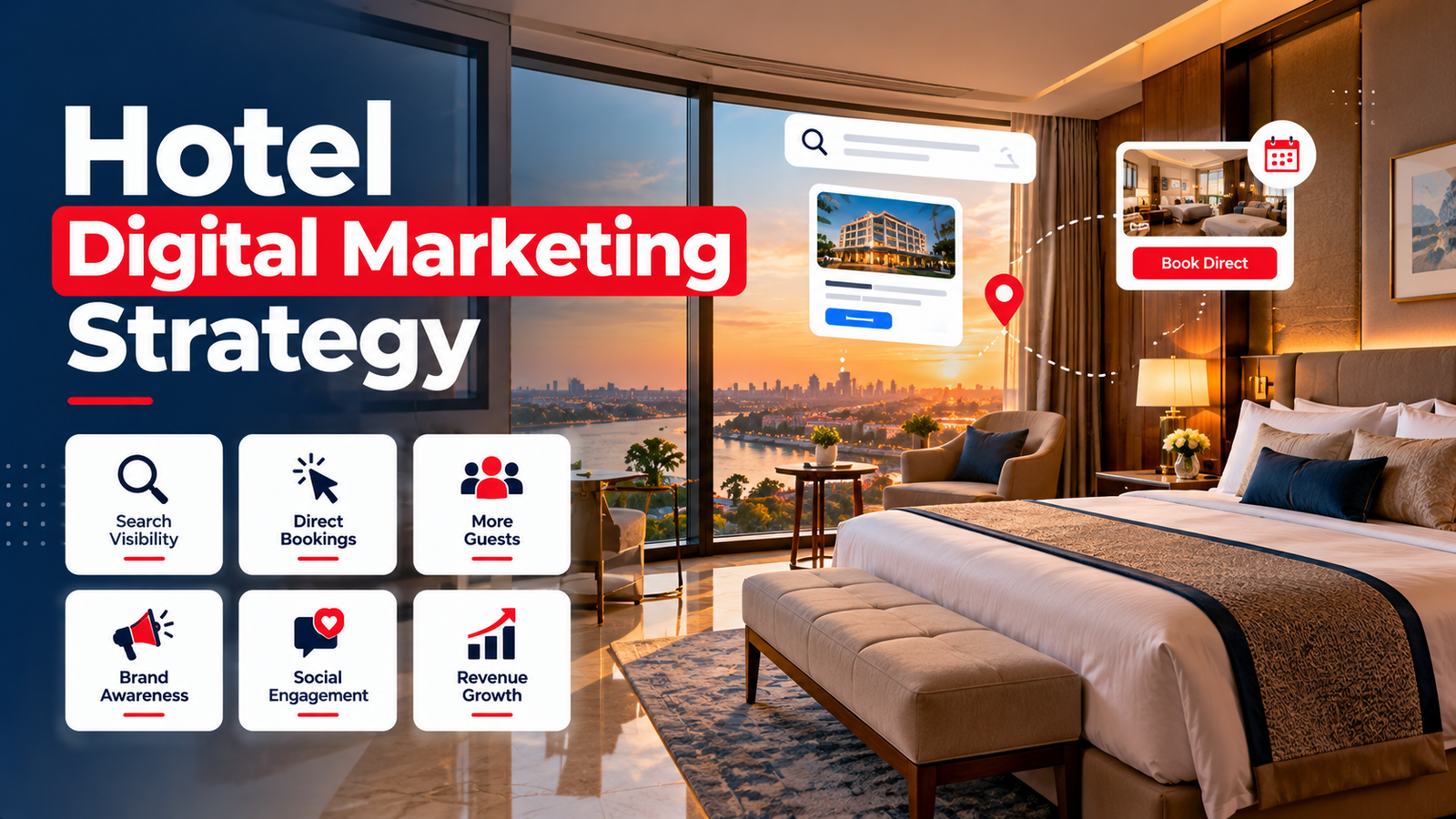
Getting more hotel bookings is not always about spending more money on advertising. Sometimes, a hotel already has good rooms, a convenient location, positive guest reviews and competitive rates, but its website still receives very few direct reservations.
In other cases, the hotel receives plenty of bookings through platforms like Booking.com, MakeMyTrip or Agoda but struggles to attract guests through its own website.
Both situations point to the same problem: the hotel needs a more structured marketing approach.
A winning digital marketing strategy for hotels connects the right travelers with the right rooms, at the right time, through the most suitable booking channels. It should improve visibility, support occupancy and help the hotel generate profitable revenue rather than simply more website traffic.
Let’s look at how hotel owners and marketing teams can build that strategy step by step.
What Is a Digital Marketing Strategy for Hotels?
A digital marketing strategy for hotels is a plan for attracting potential guests, encouraging reservations and measuring the revenue generated through online channels.
It typically combines hotel SEO, Google Search and Hotel Ads, Google Maps visibility, social media advertising, a direct booking website, online reputation management and performance measurement.
Unlike many other businesses, hotels sell rooms that are available for specific dates. An unsold room night cannot be sold again after that date has passed.
This means hotel marketing needs to consider room availability, seasonality, booking lead time, average daily rate and occupancy alongside advertising performance.
For example, promoting a hotel during an already sold-out weekend may not be useful. The same advertising budget could be more valuable when directed toward weekdays or dates with lower expected occupancy.
1. Start With Your Hotel’s Actual Revenue Goals
Before choosing marketing channels, decide what the hotel needs to achieve.
Different hotels have different priorities. A newly opened boutique hotel may need awareness and initial bookings, while an established business hotel may want to improve weekday occupancy.
A hotel with strong OTA sales may want to increase its share of direct reservations without losing valuable distribution.
Choose goals that can be measured
- Increase direct website bookings.
- Improve occupancy during low-demand dates.
- Attract more bookings for premium room categories.
- Increase average booking value.
- Reduce unnecessary customer acquisition costs.
- Generate more enquiries for group stays or event bookings.
Suppose a hotel has 40 rooms and expects weak demand on certain weekdays. Instead of running a general awareness campaign throughout the month, it could promote relevant weekday stay offers to travelers who are likely to visit during those dates.
Practical approach: Set separate targets for occupancy, direct bookings and marketing cost. A campaign that increases bookings but reduces profitability may not be a successful campaign.
2. Identify Which Guests You Actually Want to Attract
Not every traveler is the right customer for every hotel.
A luxury hotel, budget property, business hotel and family-friendly resort may operate in the same city, but guests choose them for different reasons.
Before advertising, identify your hotel’s strongest guest segments.
| Hotel type | Likely guest priority | Marketing message |
|---|---|---|
| Business hotel | Convenient location, Wi-Fi, transport and work-friendly facilities | Comfortable business stays with easy access to key areas |
| Family hotel | Room suitability, safety, dining and convenience | Comfortable stays designed for families |
| Luxury hotel | Experience, service, privacy and premium facilities | Distinctive accommodation and premium hospitality |
| Boutique hotel | Character, atmosphere and personalized experience | A memorable stay with a distinctive identity |
| Pilgrimage destination hotel | Accessibility to religious sites, transport and family convenience | Practical accommodation close to important destinations |
For instance, a hotel near Kashi Vishwanath Temple in Varanasi may attract pilgrims and families who prioritize location, room comfort and ease of travel.
A hotel serving corporate travelers may need to highlight business-friendly facilities and access to commercial areas instead.
Practical approach: Identify two or three important guest segments and create messages that address their actual booking decisions.
3. Build a Website That Makes Direct Booking Easy
Your hotel’s website should do more than display attractive photographs.
It needs to answer the questions travelers ask before making a reservation:
- What rooms are available for my dates?
- What is the total price, including applicable taxes?
- What amenities are included?
- How far is the hotel from the places I want to visit?
- What is the cancellation policy?
- Can I book securely without calling the hotel?
A good hotel website should provide clear room information, genuine property photographs, accurate amenities, a visible booking option and a reliable mobile experience.
Your booking engine matters as much as your website design
A beautiful website can still lose reservations if the booking process is slow or confusing.
The booking engine should make it easy to select dates, compare room categories, understand the final price and complete payment or reservation confirmation.
It should also synchronize inventory and rates with the hotel’s property management system or channel manager where applicable.
For example, if a traveler sees an available room on the website but encounters an error during checkout, the hotel may lose the booking even though its advertising successfully attracted the visitor.
Practical approach: Test the complete booking journey on a mobile phone, from selecting dates to receiving confirmation. Fix booking friction before increasing advertising spend.
4. Use Hotel SEO to Capture Relevant Search Demand
Search engine optimization helps travelers discover your hotel through relevant searches on Google and other search engines.
But hotel SEO is not simply about ranking for broad keywords such as “best hotels.”
Searches related to location, accommodation type, facilities and nearby attractions can be more relevant to a specific property.
Examples of hotel search intent
- Hotels near Kashi Vishwanath Temple
- Family hotel in Varanasi
- Business hotel near an airport
- Hotel with parking in a particular city
- Luxury hotel near a major tourist attraction
These examples illustrate different search intentions; they are not verified keyword-volume estimates.
Hotels should optimize their homepage for their main brand and property positioning, then develop useful pages for room categories, relevant facilities and genuine location advantages.
For example, a hotel with family suites can create a detailed family accommodation page showing room capacity, photographs, amenities and booking information.
Hotels should avoid creating dozens of nearly identical location pages for places where they do not actually operate.
Practical approach: Focus on searches that match your property’s real location, room types and guest experience.
5. Improve Google Maps and Hotel Search Visibility
Google Maps and hotel search results play an important role in hotel discovery.
Travelers frequently compare properties using location, photographs, reviews, amenities and prices before visiting a hotel’s website.
Start by maintaining an accurate, verified Google Business Profile.
Important details to review
- Official hotel name and address
- Correct website and contact information
- Genuine room and property photographs
- Accurate amenities and property details
- Guest reviews and professional responses
- Correct map location
Hotels should also understand the difference between a standard website link and Google’s hotel booking links.
Google’s free booking links can display room rates and direct travelers to eligible hotel booking websites. These links generally require connectivity through a supported booking or technology partner, along with accurate rates and availability.
According to Google’s Hotel Center documentation, free booking links do not charge for clicks, and paid Hotel Ads do not determine their organic ranking.
Practical approach: Ask your booking engine or channel manager provider whether your property is connected to Google’s free booking links and whether direct rates are being submitted correctly.
6. Run Google Ads Based on Booking Intent and Room Availability
Google Ads can help hotels reach travelers actively searching for accommodation.
However, a successful hotel advertising campaign needs more than a list of keywords and a daily budget.
Campaigns should consider the hotel’s location, room availability, expected demand and the type of guest being targeted.
Different advertising opportunities
- Branded Search: Reach travelers searching for your hotel’s name, where paid visibility is commercially justified.
- Non-branded Search: Target relevant accommodation searches by location or hotel type.
- Google Hotel Ads: Promote eligible hotel rates and availability within Google’s hotel booking experiences.
- Other campaign types: Evaluate them based on the hotel’s objectives, available assets and conversion measurement.
For example, a hotel may choose to increase advertising for dates with available inventory while reducing spending on campaigns that promote dates already likely to sell out.
Hotels should also compare advertising costs with the value of confirmed reservations rather than optimizing only for clicks.
Practical approach: Connect campaign planning with revenue management. Marketing and reservations teams should regularly review upcoming occupancy and demand together.
7. Use Social Media to Sell the Stay Experience
Hotel guests are not only buying a room. They are choosing an experience, a location and a level of comfort.
Social media is useful for showing those qualities visually.
Instead of posting only room photographs with a “Book Now” caption, hotels can create content that helps travelers imagine their stay.
Useful content ideas for hotels
- A short walkthrough of a room category
- Breakfast, dining and hospitality experiences
- Views from rooms or shared spaces
- Nearby attractions and practical travel information
- Family-friendly facilities
- Seasonal stay packages
- Real guest experiences shared with permission
Meta Ads on Facebook and Instagram can help hotels reach relevant audiences and promote suitable offers.
For example, a resort might use a short video showcasing its rooms, pool and dining facilities to introduce the property to travelers considering a weekend getaway.
Social campaigns should have a clear objective. Some are designed to build awareness, while others aim to generate booking enquiries or website reservations.
Practical approach: Use genuine property visuals and create campaigns around the guest experience rather than generic discount graphics.
8. Increase Direct Bookings Without Abandoning OTAs
Online travel agencies can be valuable distribution partners. They help hotels reach travelers who may not know the property exists.
The problem begins when a hotel depends too heavily on a single booking source or fails to develop its own direct booking channel.
A balanced strategy uses OTAs for discovery and distribution while making direct booking convenient and worthwhile.
Why direct bookings deserve attention
SiteMinder’s Hotel Booking Trends research reported that hotel websites generated an average booking value of US$516 in 2025, compared with US$312 through OTAs across its dataset.
This does not mean every direct booking generates higher profit. Hotels must still account for advertising expenses, payment costs, booking technology and other acquisition costs.
Nevertheless, the finding shows why hotels should evaluate direct bookings as an important part of their distribution strategy.
Ways to make direct booking more attractive
- Provide a smooth, secure online booking experience.
- Show clear room availability and total prices.
- Offer genuine direct-booking benefits where commercially appropriate.
- Make cancellation and payment terms easy to understand.
- Respond promptly to booking enquiries.
- Encourage repeat guests to use the hotel’s official website.
Direct-booking benefits might include flexible arrangements or added amenities, where permitted by the hotel’s distribution agreements and pricing policies.
Practical approach: Do not judge success only by the percentage of direct bookings. Compare the net revenue and acquisition cost of each booking channel.
9. Build a Marketing Calendar Around Actual Demand
Hotel demand changes throughout the year. Holidays, festivals, conferences, weddings, school vacations and local events can influence booking patterns.
Marketing campaigns should reflect those changes.
For example, hotels in Varanasi may experience different travel patterns during major religious occasions and holiday periods. A business hotel in another city may see stronger weekday demand and weaker weekends.
Rather than applying the same campaign budget throughout the year, build a calendar around the property’s booking history and upcoming demand.
Plan for three types of periods
- High-demand dates: Focus on appropriate pricing, booking efficiency and room availability rather than unnecessary discounts.
- Shoulder periods: Promote relevant experiences and offers to suitable guest segments.
- Low-demand dates: Test targeted campaigns and packages designed to improve occupancy without undermining profitability.
SiteMinder’s 2025 booking research also identified stronger demand outside traditional peak periods across many markets, reinforcing the value of planning beyond the busiest holiday dates.
Practical approach: Review your occupancy forecast at least monthly and adjust campaigns based on available rooms and expected demand.
10. Measure Booking Revenue, Not Just Leads and Website Traffic
A hotel marketing campaign may generate thousands of website visits and still produce very few reservations.
That is why hotel performance reporting should connect marketing activity with booking outcomes wherever possible.
Important hotel marketing metrics
| Metric | What it tells you |
|---|---|
| Direct bookings | How many reservations came through the hotel’s own channels |
| Booking conversion rate | The share of relevant website sessions that result in reservations |
| Cost per booking | How much marketing spend is required to generate a confirmed booking |
| Average daily rate (ADR) | Average room revenue per room sold |
| Revenue per available room (RevPAR) | Room revenue relative to the total rooms available |
| Channel acquisition cost | The cost of generating bookings through each distribution channel |
| Cancellation rate | The share of reservations cancelled before the stay |
Where possible, connect your booking engine with analytics and advertising reporting so that completed reservations can be distinguished from booking-button clicks.
Do not treat every WhatsApp message, phone call or booking-engine visit as a confirmed reservation.
A simple profitability example
Suppose a hotel receives a direct reservation worth ₹10,000 and spends ₹1,000 in attributable advertising and booking costs to acquire it.
Its acquisition cost is 10% of booking revenue, before accounting for room operating costs and other expenses.
Now suppose an OTA booking of the same value carries a hypothetical 18% distribution commission. The OTA distribution cost would be ₹1,800.
In this simplified example, the direct channel has a lower acquisition cost. But the result could reverse if the hotel needs to spend more on advertising to generate the reservation.
Practical approach: Compare channels using actual booking revenue, acquisition costs, cancellations and net contribution, not assumptions that direct bookings are always cheaper.
How to Build a 90-Day Digital Marketing Plan for Your Hotel
A practical hotel marketing strategy does not require launching every marketing channel at once.
Start by fixing the booking experience, then improve visibility and scale the channels that produce worthwhile results.
| Period | Priority actions | Outcome to evaluate |
|---|---|---|
| Days 1–30 | Audit website and booking engine, review channel costs, identify guest segments, check Google Business Profile and tracking | Clear baseline and prioritized improvement plan |
| Days 31–60 | Improve priority website pages, update property content, address booking friction and test relevant search campaigns | Better booking experience and initial campaign data |
| Days 61–90 | Refine advertising, develop experience-focused social content, review free booking link connectivity and compare booking costs | Evidence for deciding which channels to scale |
This is an implementation roadmap, not a guarantee of increased bookings within 90 days. Results depend on the property, demand, pricing, competition and execution.
Common Hotel Digital Marketing Mistakes to Avoid
- Running ads without a reliable booking engine: Paid traffic cannot compensate for a broken reservation process.
- Promoting every date equally: Campaigns should consider occupancy and demand.
- Competing only on price: Guests may also value location, service, convenience and experience.
- Ignoring OTA acquisition costs: Booking volume alone does not establish profitability.
- Using outdated property photographs: Misleading expectations can damage guest trust.
- Tracking enquiries as bookings: A click or message is not the same as a confirmed reservation.
- Depending on a single channel: A balanced distribution strategy reduces concentration risk.
Should You Hire a Hotel Digital Marketing Agency?
Hotel marketing requires coordination between advertising, website performance, reservations and revenue management.
A marketing agency can help organize these activities, but hotel owners should look beyond promises of more traffic or cheaper leads.
Ask potential partners how they measure confirmed bookings, manage seasonal campaigns, optimize direct booking journeys and evaluate channel acquisition costs.
At PayPerCliq, a digital marketing agency in Varanasi, we help businesses develop performance-focused online marketing strategies.
Our hotel digital marketing agency services are designed around hotel visibility, relevant guest acquisition, direct booking opportunities and measurable marketing performance.
Whether you’re managing a boutique property, independent hotel or hospitality business, the starting point is understanding your guests, booking channels and revenue objectives.
Frequently Asked Questions About Hotel Digital Marketing
What is the best digital marketing strategy for hotels?
The best strategy depends on the hotel’s guest segments, location, room availability and revenue goals. A practical approach usually combines a reliable direct booking website, relevant search visibility, online reputation management and carefully measured advertising.
How can hotels get more direct bookings?
Hotels can improve direct bookings by making their official website easier to use, offering clear room information and pricing, maintaining strong Google visibility and providing a smooth booking experience. Eligible properties can also explore Google’s free booking links.
Is SEO or Google Ads better for hotels?
Both can be useful. SEO helps hotels build organic visibility over time, while Google Ads can provide paid exposure for relevant searches. The right mix depends on competition, budget, booking demand and how well each channel converts into reservations.
Should hotels stop using Booking.com and other OTAs?
Not necessarily. OTAs can introduce a hotel to new travelers and provide valuable distribution. Hotels should evaluate OTA bookings alongside direct reservations and aim for a profitable balance rather than relying entirely on one channel.
How much should a hotel spend on digital marketing?
There is no universal budget. Marketing investment should reflect room revenue goals, occupancy forecasts, seasonality, acquisition costs and competition. Start with measurable objectives and adjust spending based on actual booking performance.
How do you measure the success of hotel digital marketing?
Track confirmed bookings, booking revenue, conversion rates, cost per booking, channel acquisition costs and relevant hotel revenue metrics. Website traffic and enquiries can provide useful context, but they should not be confused with completed reservations.
Final Thoughts
A winning hotel marketing strategy is not about appearing on every platform or spending the most money on advertisements.
It is about understanding who books your rooms, how they discover your property, what convinces them to reserve and how much each booking costs to acquire.
Start with a reliable website and booking engine. Improve relevant search visibility, use advertising strategically, show the real guest experience and measure performance against confirmed booking revenue.
If you’re looking for a more structured approach, explore PayPerCliq’s hotel digital marketing services or contact our team on WhatsApp to discuss your hotel’s marketing goals.
