
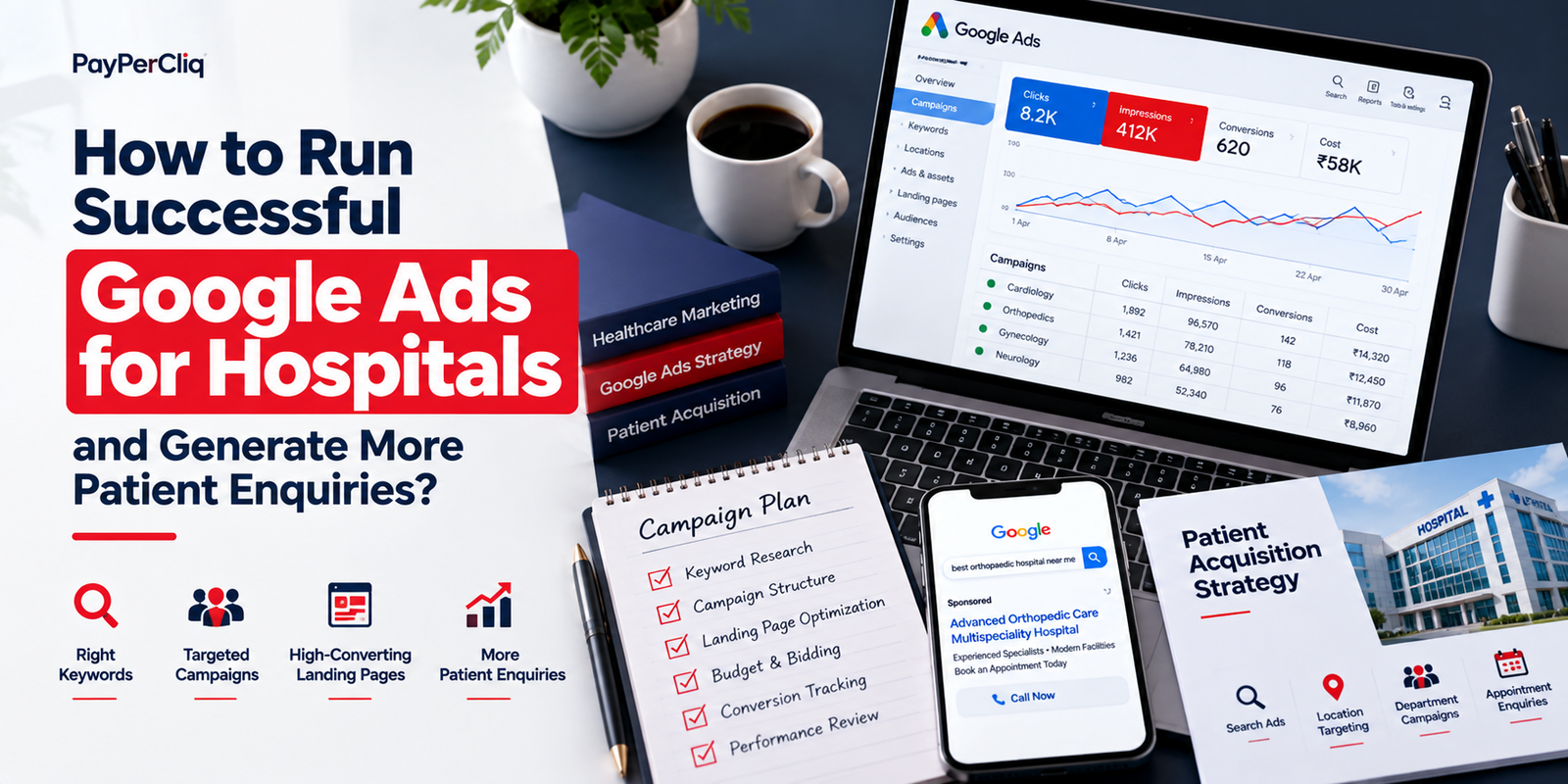
Running Google Ads for a hospital is not the same as advertising a regular business. Patients search for different medical services, treatment options, specialists and hospitals depending on their needs. A person looking for an orthopedic consultation may have a completely different requirement from someone searching for maternity services.
Yet many hospitals make a common mistake: they run one general Google Ads campaign promoting every department and send all visitors to the hospital homepage.
This approach can make it difficult to understand which services generate enquiries, where the advertising budget is being spent and whether the right people are reaching the right pages.
A successful hospital Google Ads strategy starts with relevant search intent, department-specific campaigns, useful landing pages and reliable performance tracking. It also requires careful attention to healthcare advertising policies and patient privacy.
In this guide, we’ll explain how hospitals can plan and manage Google Ads campaigns more effectively.
Are Google Ads Effective for Hospitals?
Google Ads can be an effective marketing channel for hospitals because search advertising allows eligible healthcare providers to reach people actively looking for relevant medical services.
For example, someone searching for an orthopedic hospital in their city may be looking for available specialists, hospital facilities or appointment information.
Search advertising can help the hospital appear for relevant queries, subject to competition, campaign settings, advertising policies and ad eligibility.
However, advertising visibility does not guarantee patient enquiries or appointments. Campaign performance depends on keyword selection, landing page relevance, competition, budget, website usability and the services available.
The objective should be to generate relevant enquiries, not simply attract the maximum number of clicks.
1. Start With the Right Hospital Departments
Before creating a Google Ads campaign, decide which hospital services you want to promote.
A multispecialty hospital may offer cardiology, orthopedics, gynecology, neurology, oncology, general surgery and other departments. Promoting all these specialties equally may not be the best use of the advertising budget.
Instead, evaluate departments based on:
- Availability of relevant doctors and facilities
- Current appointment capacity
- Local search demand
- Competition from other hospitals
- Hospital management’s growth priorities
- Past enquiry and appointment patterns
For example, if a hospital wants to increase enquiries for orthopedic consultations, it can begin with a focused orthopedic search campaign rather than launching campaigns for every department simultaneously.
Practical tip: Start with a few priority services, establish reliable tracking and expand only when campaign performance can be evaluated properly.
2. Structure Google Ads Campaigns by Medical Specialty
Campaign structure is one of the most important decisions in hospital PPC advertising.
Separating major specialties can help marketing teams control budgets, review search terms and measure enquiries for different hospital departments.
Example Google Ads campaign structure for a multispecialty hospital
| Campaign | Example ad group | Landing page |
|---|---|---|
| Orthopedics | Orthopedic hospital and consultation searches | Orthopedic department page |
| Cardiology | Cardiology hospital and specialist searches | Cardiology department page |
| Gynecology | Gynecology consultation searches | Gynecology department page |
| General Surgery | Relevant surgical consultation searches | General surgery department page |
| Hospital Brand | Hospital name and branded searches | Homepage or relevant location page |
This is an illustrative structure. A hospital may combine or separate campaigns depending on budget, conversion volume, location and operational requirements.
Separate campaigns are particularly useful when departments require different budgets, locations, schedules or performance targets.
Practical tip: Organize campaigns around meaningful service differences rather than creating unnecessary campaigns for every small keyword variation.
3. Choose High-Intent Keywords for Hospital Google Ads
Keyword selection determines which searches may trigger your advertisements.
Hospitals should prioritize queries that match their available services and the needs of potential patients.
Examples of service-related keywords
- Orthopedic hospital in Varanasi
- Cardiology hospital near me
- Gynecologist consultation in Mumbai
- Multispecialty hospital in Varanasi
- General surgeon consultation near me
These are illustrative examples, not verified keyword-volume or cost estimates.
Searches containing a medical specialty, service and location may indicate stronger provider-selection intent than broad informational searches.
For example, someone searching for “what is orthopedics” may be looking for general information, while someone searching for an orthopedic consultation in a specific city may be looking for a healthcare provider.
Use keyword match types carefully
Google Ads offers keyword match types that influence how closely a search must relate to the selected keyword.
Phrase and exact match keywords may provide useful starting points when a hospital wants tighter control over search relevance. Broad match can also be useful in appropriate circumstances, particularly with suitable bidding strategies and reliable conversion data.
Whatever match types you use, review the search terms report regularly.
Add negative keywords
Negative keywords help prevent advertisements from appearing for searches that are not relevant to the hospital’s campaign objectives.
Depending on the campaign, irrelevant searches might involve job vacancies, courses, educational materials or services the hospital does not provide.
However, negative keywords should be selected carefully. A term that is irrelevant to one department may be relevant to another.
Practical tip: Review actual search terms before adding exclusions instead of relying on a large generic negative keyword list.
4. Choose the Right Google Ads Campaign Type
Google offers several advertising campaign types, but hospitals should not assume that every option is equally suitable for their services.
Search campaigns
Search campaigns are often a practical starting point because they allow hospitals to advertise against relevant search queries.
They can be particularly useful for department-level campaigns where people are actively searching for a hospital, medical specialist or available service.
Performance Max campaigns
Performance Max uses Google’s automated advertising system across multiple eligible Google channels.
It may be worth evaluating when a hospital has clear campaign objectives, appropriate creative assets and reliable conversion measurement.
However, Performance Max can offer less granular control over some placements and search targeting than a conventional Search campaign. Healthcare advertising restrictions and personalized advertising policies also remain applicable.
Hospitals should not launch Performance Max simply because it is an automated campaign type.
Display and video campaigns
Display and video advertising may help with appropriate brand awareness or service communication, but they generally serve a different purpose from campaigns targeting active search demand.
Healthcare-related audience targeting and remarketing can be restricted. Hospitals must not assume that ordinary remarketing methods used in other industries are permitted for sensitive health-related advertising.
Practical tip: For a hospital starting with a limited budget, consider a focused Search campaign first, then evaluate other eligible campaign types based on objectives and compliance.
5. Write Hospital Ads That Are Relevant and Trustworthy
Effective hospital advertising should clearly communicate the service being offered without exaggerating medical capabilities or promising treatment results.
For example, an orthopedic campaign can highlight the hospital’s orthopedic department, available consultations, location and appointment options.
Advertisements should reflect information that patients can verify on the landing page.
What hospital ad copy should communicate
- The relevant medical specialty or service
- The hospital’s name and location
- Accurate information about available consultations
- Relevant facilities or professional credentials, where verified
- A clear and appropriate next step
Avoid unsubstantiated claims such as guaranteed recovery, guaranteed treatment success or being the best hospital without credible support.
Ad copy should also avoid language that suggests the advertiser knows a person’s private health condition.
Practical tip: Write advertisements for the specific department and verify that every important claim is supported by the hospital’s actual services.
6. Send Ad Traffic to the Right Hospital Landing Page
Even a well-targeted Google Ads campaign can underperform if visitors reach a page that does not answer their questions.
For example, someone clicking an advertisement about orthopedic consultations should not have to search through the hospital homepage to find the orthopedic department.
A relevant landing page reduces confusion and makes it easier for visitors to take the next step.
Essential elements of a hospital landing page
- Clear heading describing the medical department
- Accurate information about available services
- Relevant doctor profiles and qualifications
- Hospital location and contact details
- Visible appointment or enquiry option
- Mobile-friendly layout
- Fast page loading
- Appropriate privacy information
Hospital landing pages should not use misleading urgency, unsupported medical claims or unnecessary pressure to encourage appointments.
Enquiry forms should collect only the information required for an initial response. Sensitive health information requires appropriate safeguards and should not be passed through ordinary advertising tracking systems.
Practical tip: Evaluate the landing page experience before increasing the advertising budget.
7. Set a Realistic Google Ads Budget for Each Department
There is no universal Google Ads budget that works for every hospital.
Advertising costs vary by location, specialty, competition, keyword selection and campaign quality.
Instead of choosing a budget based only on what another hospital spends, begin with your own objectives.
How to estimate a starting budget
Suppose a hospital has an initial monthly advertising budget of ₹60,000 for three departments.
An illustrative allocation could be:
| Department | Illustrative monthly budget |
|---|---|
| Orthopedics | ₹25,000 |
| Cardiology | ₹20,000 |
| Gynecology | ₹15,000 |
| Total | ₹60,000 |
These amounts are examples for explaining budget allocation. They are not recommended minimum spends or estimates of actual campaign performance.
The final allocation should depend on search demand, expected click costs, department capacity and the hospital’s priorities.
Budget decisions should be reviewed after enough relevant performance data becomes available.
What about bidding strategies?
Google Ads provides automated bidding options that can optimize for clicks, conversions or other campaign goals.
Conversion-focused bidding can be useful when tracking is accurate and there is enough meaningful conversion data to support optimization.
However, hospitals should avoid treating every button click or form interaction as an equally valuable patient enquiry.
Practical tip: Build reliable conversion tracking before relying heavily on automated bidding decisions.
8. Track Patient Enquiries Without Compromising Privacy
Hospital advertising performance should not be measured only through impressions, clicks or click-through rates.
Those metrics help explain advertising activity, but they do not show whether a campaign is generating relevant patient enquiries.
Important Google Ads performance metrics
- Relevant search terms
- Cost per click
- Landing page conversion rate
- Appointment request submissions
- Relevant calls generated through advertising
- Cost per relevant enquiry
- Enquiry trends by medical department
Hospitals may also evaluate appointment outcomes through appropriately secured internal systems, subject to applicable privacy and legal requirements.
Healthcare advertising requires particular care with tracking. Diagnoses, treatment information, patient identities and other sensitive health data should not be sent to Google Ads or analytics platforms through improperly configured conversion tags, URLs, forms or integrations.
Do not upload patient lists for advertising targeting without confirming that the intended use complies with applicable platform policies and privacy law. Sensitive health-based audience targeting is restricted.
Practical tip: Work with the hospital’s privacy or compliance team when implementing advertising measurement and patient enquiry workflows.
9. Review Campaign Performance and Reduce Wasted Ad Spend
Google Ads requires ongoing review. A campaign should not be left unchanged simply because advertisements are receiving clicks.
Hospital marketing teams should regularly examine:
- Which search terms are triggering advertisements
- Which departments generate relevant enquiries
- Whether ads are reaching the intended locations
- Which landing pages convert effectively
- Whether negative keywords need updating
- How budget is distributed across departments
- Whether conversion tracking remains accurate
For example, if an orthopedic campaign receives many clicks but few relevant enquiries, investigate the search terms, ad messaging, landing page and appointment process before increasing the budget.
Likewise, a campaign with a higher cost per enquiry may still be useful if the enquiries are genuinely relevant to the department’s services.
Practical tip: Make optimization decisions based on search relevance and enquiry quality rather than a single advertising metric.
Common Google Ads Mistakes Hospitals Should Avoid
Some of the most frequent problems in hospital PPC advertising include:
- Using one campaign for every department: This can make budgets and performance harder to manage.
- Sending all clicks to the homepage: Visitors may struggle to find the relevant specialty.
- Targeting overly broad keywords: This can attract searches unrelated to the hospital’s services.
- Ignoring negative keywords: Irrelevant search traffic may consume advertising budgets.
- Using unsupported medical claims: Misleading advertising can create compliance and trust problems.
- Tracking only clicks: Click volume does not establish enquiry quality.
- Ignoring patient privacy: Inappropriate tracking can expose sensitive information.
- Changing campaigns too frequently: Constant adjustments can make performance difficult to evaluate.
Hospitals can avoid many of these problems by starting with a clear campaign structure, relevant landing pages and reliable measurement.
How Should Hospitals Combine Google Ads With SEO?
Google Ads and SEO serve different but complementary purposes.
Google Ads provides paid visibility for eligible searches, while SEO helps build organic visibility through useful website pages, technical improvements and relevant content.
For example, a hospital can run a Google Ads campaign for orthopedic consultations while improving the orthopedic department page for relevant organic searches.
The same department page may support both channels, provided it offers a good experience and meets advertising requirements.
For a broader organic search strategy, read our guide on how to build a winning hospital SEO strategy.
You can also explore our article on digital marketing strategies for multispecialty hospitals to understand how paid advertising fits into a department-wise marketing plan.
Should Hospitals Hire a Google Ads Agency?
Hospital Google Ads management requires more than selecting keywords and launching advertisements.
Campaign managers need to understand medical specialties, search intent, advertising policies, landing page relevance, budgets and privacy-conscious conversion measurement.
When choosing a marketing partner, hospitals should ask how campaigns will be structured, how enquiry quality will be evaluated and how the agency handles healthcare advertising restrictions.
PayPerCliq is a digital marketing agency in Varanasi with experience working with hospitals, doctors and healthcare businesses.
Our approach combines relevant advertising strategies, landing page optimization and performance reporting to help organizations make informed marketing decisions.
Explore our hospital digital marketing services for SEO, Google Ads and other performance-focused marketing solutions.
For organizations operating across different healthcare specialties, we also provide healthcare digital marketing services.
Frequently Asked Questions About Google Ads for Hospitals
Can hospitals advertise on Google Ads?
Yes, many hospitals can advertise eligible healthcare services through Google Ads. However, advertisements must comply with Google’s healthcare and medicines policies, personalized advertising restrictions and applicable local regulations. Some services require certification or are restricted in particular locations.
Which Google Ads campaign type is best for hospitals?
Search campaigns are often a useful starting point for hospitals targeting people actively looking for medical services. Other campaign types may also be appropriate depending on the hospital’s objectives, available conversion data and advertising eligibility.
How much should a hospital spend on Google Ads?
There is no fixed budget suitable for every hospital. The appropriate amount depends on location, specialty, competition, search demand and the hospital’s objectives. Start with a manageable budget and review relevant enquiry performance before expanding.
Can Google Ads generate patient enquiries for hospitals?
Google Ads can help hospitals reach people searching for relevant services and may contribute to appointment enquiries. Results depend on targeting, advertising eligibility, landing page quality, competition and the enquiry process.
Should hospitals run separate Google Ads campaigns for each department?
Separate campaigns can be useful when departments require different budgets, locations or performance targets. However, smaller hospitals may combine closely related services when budgets or conversion volumes do not justify a more complex structure.
Conclusion
Successful Google Ads for hospitals begin with understanding which medical services people are searching for and how to connect those searches with accurate, useful hospital information.
Start with priority departments, select relevant keywords, build focused campaigns and send visitors to appropriate landing pages. Then measure relevant enquiries and review performance regularly.
Most importantly, ensure that every campaign respects healthcare advertising policies and patient privacy.
If your hospital wants a structured approach to paid advertising, explore PayPerCliq’s hospital digital marketing services or contact our team on WhatsApp to discuss your requirements.
