
Search is changing. People no longer rely only on Google to find products, compare businesses or choose service providers.
Today, they also ask ChatGPT, Google Gemini, Google AI Overviews, AI Mode, Perplexity and other AI-powered platforms for recommendations.
Instead of searching for “best digital marketing agency”, someone might ask:
- “Which digital marketing agencies have experience with luxury fashion eCommerce brands?”
- “Where can I buy authentic handloom Banarasi silk sarees online?”
- “Which hotels near Kashi Vishwanath Temple are suitable for families?”
- “What should I check before choosing an SEO agency for my business?”
These questions are more conversational, specific and focused on solving a problem.
For businesses, this creates an important opportunity—and a challenge.
How do you make sure your brand is discoverable, accurately represented and considered when AI systems help users make decisions?
The answer is not simply publishing more blogs, repeating keywords or adding AI-related terminology to your website.
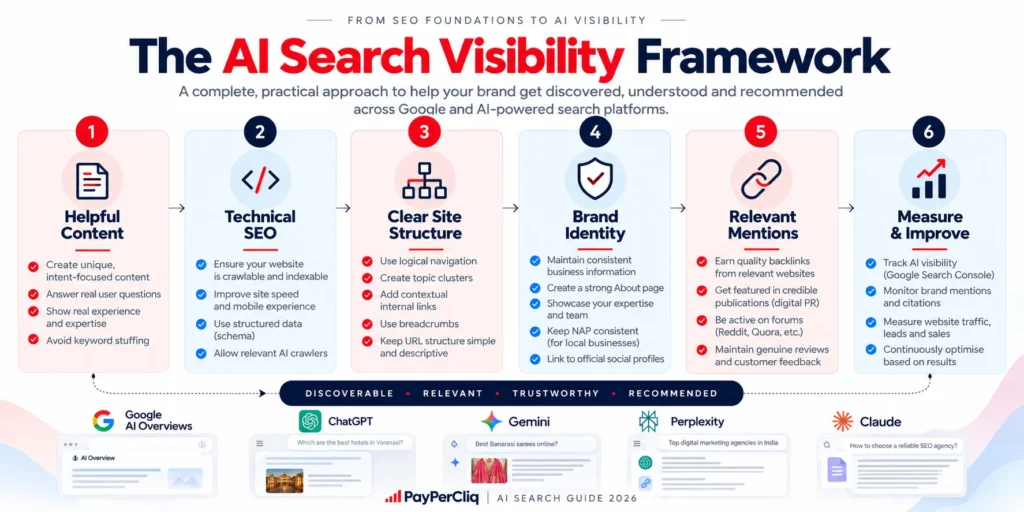
It requires a connected approach to content, technical SEO, site architecture, brand identity, authority and online reputation.
In this guide, we’ll explain the foundations of AI search visibility, how it relates to traditional SEO and the practical steps businesses can take to strengthen their digital presence.
1. Understanding AI Search: What Has Changed?
Traditional search engines generally show a list of relevant web pages for a user’s query.
AI-powered search experiences can go further by interpreting the question, retrieving information from multiple sources and presenting a summarized response. Depending on the platform and query, they may also show supporting links, citations, products, business information or recommendations.
Consider two searches.
Traditional search: “Banarasi wedding sarees”
The user may see collection pages, product listings, shopping results and articles.
Conversational AI search: “Where can I buy an authentic Banarasi wedding saree online, and how do I check whether it is handwoven?”
Now the user is asking for a trustworthy seller and buying guidance at the same time.
An AI-powered response may draw on information about retailers, craftsmanship, buying considerations, product availability and third-party references.
This creates a broader challenge for brands: their websites must not only be discoverable but also provide useful, accurate information that addresses the questions potential customers ask.
What does AI search visibility mean?
AI search visibility refers to how frequently and accurately your brand, website, products or services appear in AI-powered discovery experiences.
It can take several forms:
Brand mention: An AI response names your business while answering a relevant question.
Citation: The response provides a link to one of your website pages or another source discussing your brand.
Product discovery: A product, retailer or shopping result is shown during an AI-assisted buying journey.
Referral traffic: Someone clicks a link from an AI-powered platform and visits your website.
Business consideration: A potential customer discovers your brand through an AI response and later contacts you, searches for your business or makes a purchase.
These outcomes are related, but they are not identical. A brand can be mentioned without receiving a website citation, and a citation does not always generate traffic.
Is traditional SEO still important?
Absolutely.
Google’s official guide to optimizing websites for generative AI search, published in May 2026, makes it clear that established SEO best practices remain relevant.
Read Google’s official generative AI optimization guidance.
For Google AI Overviews and AI Mode, crawlability, indexability, useful content and established search systems remain foundational.
However, different AI platforms have different retrieval methods and sources. No single optimization technique guarantees visibility across all of them.
The practical goal is to build a website and brand that can be reliably discovered, understood and evaluated.
2. The Foundation: Start With Your Business, Audience and Search Intent
Before optimizing any page, identify three things:
- What does your business actually offer?
- Who is the intended customer?
- What is that customer trying to accomplish when searching?
These questions sound simple, but many websites lose clarity by trying to rank every page for too many different topics.
A page selling a product should help someone evaluate and buy that product.
A service page should explain the service, who needs it, what is included and how to enquire.
An informational article should answer a specific question with enough useful detail that the reader can make progress.
Understand the difference between search intent and keywords
A keyword describes what someone types into a search engine.
Search intent describes what they want to achieve.
For example:
| Search query | Likely intent | Best page type |
|---|---|---|
| Banarasi wedding sarees online | Shop for wedding sarees | Collection page |
| What is Katan silk? | Understand a fabric | Educational article |
| Pure Katan silk saree price | Research or compare prices | Buying guide or relevant collection |
| Banarasi saree shop in Varanasi | Find a local seller | Local commercial page |
| How to identify a handloom Banarasi saree | Verify authenticity | Detailed educational guide |
A website that treats all these queries as interchangeable may struggle to give each visitor the most relevant experience.
Our recommendation: build every important page around a clear primary purpose, then support that purpose with genuinely relevant information.
This does not mean a page must discuss only one keyword. It means related information should support the same user goal rather than compete with it.
3. On-Page SEO: Make Every Page Clear, Relevant and Helpful
On-page SEO involves improving the content and information presented on individual website pages.
In AI search, clarity is particularly valuable because pages may need to answer specific questions within a much larger conversation.
Create original content instead of repeating what competitors say
Many businesses publish nearly identical articles.
They follow the same headings, use similar explanations and add a few keywords without providing anything readers cannot find elsewhere.
A better approach is to introduce information based on real experience.
For example, a Banarasi saree retailer can explain:
- How different weaving techniques affect appearance and pricing.
- What customers should verify before purchasing a handloom saree.
- How fabric construction affects drape and comfort.
- Why two sarees that look similar may have different prices.
A hospital can explain common patient questions using medically reviewed information.
A hotel can publish accurate details about its location, rooms, amenities, nearby landmarks and booking options.
An SEO agency can show how its specialists approach page audits, content planning, internal linking and performance measurement.
These examples are valuable because they answer genuine customer questions using experience and context.
Google’s people-first content guidance similarly emphasizes originality, usefulness and transparent expertise.
Use one clear H1 and meaningful supporting headings
Your H1 should tell visitors what the page is about.
For a wedding-saree collection, a suitable H1 might be:
Banarasi Wedding Sarees
You do not need to expand it into a long string of fabrics, colours, designs and occasions.
Use H2 and H3 headings for useful supporting information, such as choosing a saree for a wedding or understanding the collection’s craftsmanship.
Headings should describe the content underneath them.
A reader should be able to scan the page and understand its structure.
Write meta titles and descriptions for people
A good meta title communicates the page’s topic and purpose.
A meta description gives users a reason to visit.
For a collection page:
Example meta title: Banarasi Wedding Sarees Online | Brand Name
Example meta description: Explore Banarasi wedding sarees selected for traditional celebrations. Browse the collection, compare styles and discover craftsmanship and buying details.
The objective is clarity, not inserting every secondary keyword.
Google may generate its own title link or search snippet, so metadata should also match the visible page content.
Stop repeating exact-match keywords unnecessarily
Search engines can interpret related phrases and context. You do not need to force the exact keyword into every paragraph.
If your page is about Banarasi wedding sarees, it is natural to write about wedding attire, craftsmanship, comfort and choosing the right saree.
However, repeatedly inserting phrases like red Banarasi sarees, georgette Banarasi sarees, tissue Banarasi sarees, satin Banarasi sarees without a clear reason makes the page less focused and less useful.
A better question to ask is:
Would this sentence help someone understand, compare or purchase the products on this page?
If not, reconsider whether it belongs there.
Avoid unnecessary repetition
Long content is not automatically better content.
If one section has already explained that handloom sarees are made on traditional looms, another section should not simply repeat that statement using different words.
Instead, add something new: identification, buying considerations, care, pricing or a relevant example.
Every section should provide additional value.
4. AI SEO for eCommerce: How to Optimize Collection Pages
This is one of the most important areas for online stores.
Collection pages often target high-value commercial searches. However, many eCommerce businesses try to turn each collection into a complete blog article.
The result can be a page filled with repeated keywords that pushes the products—the main reason people visited—too far down.
We recommend a more practical structure.
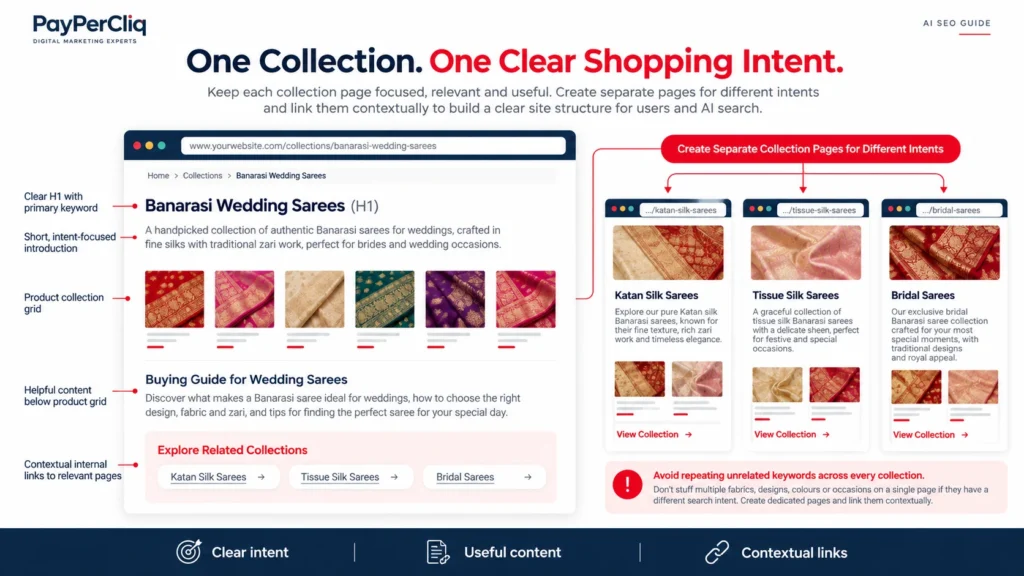
Step 1: Use a precise collection heading
Suppose an online store sells Banarasi sarees and has a dedicated wedding collection.
A clear H1 would be:
Banarasi Wedding Sarees
The page should primarily serve people looking for sarees suitable for weddings.
It does not need to compete equally for every fabric, design and colour-related query.
Step 2: Add a short introduction above the product grid
The introductory content should immediately explain what the collection offers.
Example:
Explore Banarasi wedding sarees selected for traditional ceremonies and celebrations. Discover sarees with elegant weaving, zari detailing and styles suited to brides, family members and wedding guests. Browse the collection to compare available designs, fabrics and prices.
This introduction establishes the page’s purpose without stuffing keywords.
It also lets shoppers reach the products quickly.
Step 3: Keep the product grid central to the experience
The collection grid should contain the products users expect.
Accurate product titles, images, prices, availability, filters and links are often more useful to shoppers than several paragraphs of introductory text.
Avoid displaying unrelated products merely because they are associated with popular search terms.
A wedding collection should contain products genuinely appropriate for that category.
Step 4: Add helpful buying information below the grid
The content below the products can answer questions that help customers make decisions.
For example:
How to Choose a Banarasi Saree for a Wedding
Explain how the buyer might consider fabric, craftsmanship, comfort, occasion and budget.
You can mention relevant designs and fabrics when they help explain the products being sold.
That is different from adding unrelated keyword-rich paragraphs just to target additional searches.
Step 5: Create separate pages for distinct shopping intents
If the business also sells Katan silk, tissue silk and bridal sarees, dedicated collection pages may be appropriate when there is enough distinct inventory and real search demand.
A possible structure:
/collections/banarasi-wedding-sarees/collections/katan-silk-sarees/collections/tissue-silk-sarees/collections/bridal-banarasi-sarees
These URLs are illustrative, not recommendations to create all four automatically.
Before adding a new collection, check whether it meets a distinct customer need, has sufficient products and deserves an independently useful page.
Do not create near-identical collections just to target minor keyword variations.
Step 6: Use contextual internal links
Once you have relevant pages, connect them naturally.
For example:
Looking for a traditional silk option? Explore our Katan silk saree collection.
The linked text helps visitors understand where the link will take them.
You can similarly link from an educational article about handloom sarees to a relevant product collection.
This gives people useful pathways through the website and helps search engines discover the relationship between pages.
Step 7: Support collection pages with specific product information
Collection pages introduce product groups. Product pages should provide detailed information about individual items.
For a saree, useful information may include fabric composition, dimensions, weaving technique, care instructions, price, stock status and clear photographs.
Use accurate product-specific structured data where applicable.
Google recommends focusing merchant-listing Product markup on individual product pages rather than trying to obtain individual-product rich results through broad collection pages.
See Google’s merchant-listing structured data guidelines.
The key principle: collection pages should serve collection intent; product pages should explain individual products; educational articles should answer informational questions. Connect them when relevant.
Businesses looking for professional assistance can explore our AI SEO services in Varanasi, covering content relevance, technical SEO, entity optimization and AI search readiness.
5. Technical SEO: Make Your Content Accessible and Understandable
Even excellent content may struggle to perform if search systems cannot access it properly.
Technical SEO provides the underlying structure that supports discovery, crawling, indexing and a usable website experience.
Check crawling and indexing
Start by confirming that important pages can be discovered and indexed.
Review:
robots.txtaccess rules.- Meta robots directives and
noindextags. - Canonical URLs.
- XML sitemaps.
- Internal links to important pages.
- HTTP status codes.
- Redirect chains and broken links.
- Content that depends heavily on JavaScript.
Google Search Console’s URL Inspection tool can help identify whether Google can access and index a specific page.
Remember that allowing crawling does not guarantee indexing, ranking or appearance in an AI answer.
Understand AI crawlers before changing robots.txt
A common recommendation is to “allow all AI bots.”
That advice is too broad.
Different crawlers may serve different purposes.
For example, OpenAI identifies:
OAI-SearchBot: Used for discovery in ChatGPT’s search features.
GPTBot: Used for crawling content that may contribute to training OpenAI’s generative AI foundation models.
ChatGPT-User: Used for certain user-initiated page visits rather than continuous automatic search crawling.
A website owner can choose different access policies for different crawlers.
If ChatGPT Search visibility is important, check that relevant search crawling is permitted and that server or security systems are not unintentionally blocking it.
You do not have to allow training crawlers simply to pursue search visibility.
Read OpenAI’s official crawler documentation.
For Google AI Overviews and AI Mode, focus on Google’s Search indexing and eligibility requirements.
Also check whether your CDN, firewall or bot-protection service is preventing legitimate crawlers from accessing publicly available content.
Build a logical website structure
Important pages should be easy to find through navigation and internal links.
For example, a digital marketing agency might use:
Home → Services → SEO Services → Local SEO Services
An eCommerce website might use:
Home → Sarees → Banarasi Wedding Sarees → Individual Product
A structure like this helps customers find relevant information.
It also makes the relationships between major pages easier to understand.
Use breadcrumbs
Breadcrumb navigation shows where a page sits within the website.
It can help shoppers navigate from a product back to a collection and help visitors understand the site hierarchy.
Where appropriate, use BreadcrumbList structured data that reflects the visible navigation.
Improve mobile usability and page performance
A large share of browsing and shopping happens on mobile devices.
Check that pages load reliably, text is readable, buttons are easy to use, and important information is not hidden behind broken scripts or intrusive elements.
Pay attention to Core Web Vitals, image optimization, layout stability and server response times.
Technical performance alone does not create authority, but poor usability can undermine even strong content.
Keep important information available as text
Infographics, screenshots and videos can make a page more engaging, but they should not be the only place where essential information appears.
If an infographic explains your process, include a concise written explanation nearby.
If a chart contains important results, provide the key values in surrounding text.
Use descriptive image alt text for meaningful images and accessible labels where appropriate.
This helps people using assistive technologies and gives crawlers accessible context beyond the visual itself.
6. Structured Data: Help Search Engines Understand Your Pages
Structured data, often implemented using Schema.org vocabulary, provides machine-readable descriptions of content and entities.
It can help eligible search features understand the relationships between a business, its pages, products and other information.
Relevant types may include:
| Website or page | Structured data to consider |
|---|---|
| Company website | Organization |
| Eligible local business | LocalBusiness or a relevant subtype |
| Educational article | Article or BlogPosting |
| Product detail page | Product and Offer |
| Website hierarchy | BreadcrumbList |
| Applicable business service | Service, where semantically appropriate |
| FAQ content | FAQPage, if applicable and accurate |
Structured data must match information that is actually visible and supported on the website.
For example, don’t add product ratings that your business has not received, fabricate reviews or mark up services that aren’t offered.
Does schema guarantee AI citations?
No.
Google states that there is no special AI Overview or AI Mode schema required to appear in those experiences.
Structured data should be treated as part of a sound technical and content strategy, not as a guaranteed citation mechanism.
Read Google’s AI search eligibility guidance.
7. Build Topic Clusters Without Creating Duplicate Content
A topic cluster is a group of related pages that cover a subject from different angles.
The purpose is to help readers explore relevant questions without forcing one page to cover every possible intent.
Consider an SEO agency.
Its main SEO services page explains the agency’s commercial offering.
Supporting informational articles might cover:
- How technical SEO audits work.
- Why internal linking matters.
- How local SEO differs from general SEO.
- How businesses can measure AI search visibility.
- Common reasons Google does not index a page.
Each article should answer a distinct question.
Relevant pages can link to the broader service page, and the service page can link to helpful educational resources.
For example, businesses seeking comprehensive optimization can explore PayPerCliq’s SEO services, while businesses focused on local discovery can learn about Local SEO and Google Maps optimization.
Avoid creating multiple pages for essentially the same query
Publishing five articles that all answer “How to rank in ChatGPT” using different titles rarely creates five distinct resources.
Instead, consider maintaining one comprehensive guide and creating separate supporting articles only when they cover genuinely different questions.
For example, an article about AI crawler access can be useful independently because it solves a technical problem.
An article about measuring AI citations serves a different purpose.
The objective is not maximizing the number of URLs. It is building a useful collection of connected resources.
8. Brand Entity SEO: Make Your Business Easy to Identify
A brand is more than a name or logo.
For search and AI discovery, people need accurate information about what the business does, where it operates, who is responsible for it and what makes its products or services relevant.
This is where brand entity optimization becomes important.
What is a brand entity?
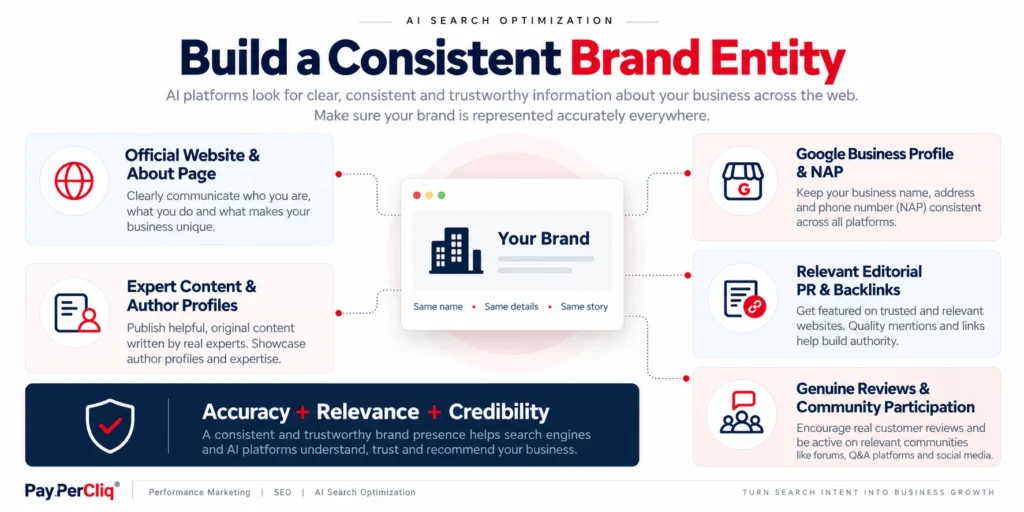
In practical terms, a brand entity is a distinct business identity supported by consistent information across relevant sources.
For example, a company profile may include:
- The business name and official website.
- Its products and services.
- Physical location or areas served.
- Founders, leadership or relevant specialists.
- Contact details.
- Industry and areas of expertise.
- Relevant social profiles.
- Authentic external references.
There is no universal public checklist that guarantees a search engine or AI model will recognize or recommend a particular business.
The goal is to reduce ambiguity and make reliable information easy to verify.
Build a meaningful About Us page
An About page should answer basic questions clearly.
Who started the company? What does it do? Who does it help? Where does it operate? What expertise does the team have?
Avoid filling it only with broad claims such as “industry-leading,” “world-class” or “number one.”
Where appropriate, include genuine team information, experience, business history and links to relevant work.
An eCommerce brand can explain its manufacturing or sourcing process.
A specialist retailer can describe its product expertise.
A service provider can explain the qualifications and experience behind its recommendations.
Maintain consistent NAP information
For businesses with a physical presence, NAP refers to Name, Address and Phone Number.
Use accurate business details across your website, Google Business Profile, relevant directories and other company profiles.
A business can naturally have multiple locations or different contact numbers for different departments. Consistency means presenting those details accurately, not forcing every platform to contain identical text.
Where useful, maintain a clear contact page and mention the locations you genuinely serve.
Connect your official brand profiles
Your website may link to verified company profiles on platforms such as LinkedIn, Instagram, Facebook, YouTube and industry-specific directories.
Relevant Organization structured data can also identify authentic official profiles through suitable properties such as sameAs.
These connections are helpful for clarity, but they should not be represented as a way to force AI recommendations.
Demonstrate real expertise
If an article requires professional knowledge, identify who wrote or reviewed it.
Include a concise, accurate author biography and link to relevant professional information where appropriate.
Do not invent author credentials or fake firsthand experience.
People should be able to understand why the information is worth trusting.
9. Off-Page SEO: Focus on Relevance, Not Backlink Quantity
Off-page SEO involves signals and references that exist outside your own website.
Links remain important to web discovery and search, but buying large numbers of low-quality backlinks is not a sustainable authority-building strategy.
A common mistake is evaluating every possible backlink opportunity by Domain Authority or Domain Rating alone.
Third-party authority metrics can help with research, but they do not independently establish whether a website is a good editorial fit.
How should you evaluate a backlink opportunity?
Start with these questions:
Is the website relevant? A textile publication discussing weaving may be more useful to a saree brand than an unrelated generic website.
Does it publish genuine content? Review its editorial quality, authorship and usefulness.
Does it have a real audience? Look for signs of genuine readers, community participation and topical consistency.
Is the link contextually appropriate? A relevant reference inside a useful article is more meaningful to readers than a random homepage link.
Is the opportunity trustworthy? Avoid networks created primarily to sell links, publish scraped content or manipulate rankings.
You may find ten relevant editorial references more useful than fifty unrelated links. That is a quality principle, not a fixed numerical ranking rule.
Earn links through useful information
Businesses can attract relevant references through:
- Original research and surveys.
- Detailed industry guides.
- Expert commentary.
- Useful tools or resources.
- Genuine partnerships.
- Well-documented case studies.
- Relevant educational contributions.
For example, an SEO agency that publishes an original analysis of search performance may provide information another publication finds worth referencing.
That’s more sustainable than publishing generic guest posts across unrelated websites.
10. Digital PR: Build Credibility Beyond Your Own Website
Digital public relations is another important part of a broader visibility strategy.
A brand’s online reputation is influenced by what it says about itself and what other credible sources say about it.
Relevant coverage can introduce a company to new audiences, create useful brand references and sometimes earn editorial links.
What kind of PR is valuable?
Prioritize genuine, newsworthy information.
Examples include:
A local manufacturer introducing a meaningful innovation.
A hospitality company sharing original tourism or travel data.
An eCommerce brand publishing research about customer buying behaviour.
An industry expert contributing accurate commentary to a relevant publication.
A business documenting a substantial milestone with verifiable details.
These stories provide value to readers beyond promoting the company name.
Avoid bulk press release distribution
Publishing essentially the same promotional article across dozens of low-quality websites may create many URLs, but not necessarily meaningful recognition.
One genuinely useful story in a publication with an interested audience can be more valuable than repetitive placements without editorial relevance.
Digital PR should support credibility and awareness rather than serve as a link-counting exercise.
Keep your brand story consistent
Suppose a business specializes in authentic handwoven textiles.
Its website discusses craftsmanship, but its social media focuses on unrelated products and its PR claims are exaggerated.
That inconsistency can create confusion for customers.
Keep the core facts aligned across the website, articles, social channels, interviews and company profiles.
11. Forums and Communities: Reddit, Quora and Industry Discussions
People often look for experiences and recommendations from other customers.
Discussion platforms can contain useful firsthand information, comparisons and questions that traditional business websites do not address.
These communities are also discoverable through search, and some AI-powered tools may reference public discussions when relevant.
That does not mean every business should start publishing promotional answers on Reddit or Quora.
Participate where you can genuinely help
Suppose someone asks:
“How can I tell if a Banarasi saree is handwoven?”
A textile specialist can provide a practical explanation of weaving characteristics, seller questions and limitations of visual identification.
The answer should be useful even if the reader never visits the company’s website.
Similarly, a digital marketing specialist can discuss how to distinguish call-button clicks from connected calls, or what makes Google Maps campaigns effective.
The value comes from expertise, not repeatedly inserting brand names and links.
Follow community rules
Some forums restrict self-promotion, external links or commercial participation.
Respect those rules. Disclose relevant affiliations when discussing your company or its services.
Avoid fake testimonials, fabricated customer discussions, coordinated upvoting or posting the same answer across multiple communities.
The long-term opportunity is to become a credible participant in relevant conversations.
12. Social Media: Build a Consistent and Discoverable Brand
Your website should not be the only place customers learn about your business.
For many buyers, a social media account is part of the research process.
They may discover a product on Instagram, check reviews on Google, read an article on your website and later ask an AI platform for recommendations.
Social media can therefore contribute to brand awareness, trust and discoverability.
Publish content that supports your expertise
A fashion brand can demonstrate product craftsmanship, collections and styling.
A hotel can show authentic room photographs, facilities and useful location information.
A healthcare provider can share appropriately reviewed educational information.
An agency can publish practical campaign analysis, educational content and documented client work.
The objective is not posting daily simply to maintain a schedule.
Post consistently at a frequency your team can support while maintaining quality and accuracy.
Maintain consistent brand information
Check that profile names, website links, descriptions, locations and contact information are current.
Use recognizable branding across channels.
Where possible, direct users to relevant pages rather than always sending everyone to the homepage.
Important: Social media engagement is not a guaranteed direct ranking signal for AI responses. Its value lies in helping people discover, evaluate and recognize the brand and in creating legitimate public information.
13. Local Businesses: Google Business Profile and Local Search Visibility
For hotels, clinics, restaurants, showrooms and other local businesses, Google Business Profile remains an important part of online discovery.
A person may search for a nearby service, compare ratings, check opening hours or request directions without visiting a website first.
AI-assisted local discovery also depends on access to accurate business information.
Optimize your Google Business Profile
Start with the basics:
- Correct business name and primary category.
- Accurate address or service area.
- Current phone number and website.
- Opening hours and applicable special hours.
- Relevant services and products.
- Genuine photographs.
- Accurate business description.
- Timely responses to customer questions and reviews.
Add updates when there is something useful to communicate, such as changed hours, a new service, an event or a genuine offer.
Daily posting is not a universal requirement for better rankings.
Encourage genuine customer reviews
Reviews help potential customers assess businesses.
Create a consistent process for requesting honest feedback from real customers.
Respond professionally to both positive and negative reviews.
Never buy reviews, fabricate testimonials or offer incentives in ways that violate platform rules.
A detailed genuine review explaining a customer’s experience is more useful to other customers than an artificially generated review full of keywords.
Connect your website and local presence
Your website should support your Business Profile information.
A hotel might have pages explaining its rooms, location and nearby landmarks.
A clinic might have separate pages for actual specialties or services.
A showroom might provide directions, operating hours and relevant product categories.
For a deeper explanation, explore PayPerCliq’s Local SEO services in Varanasi.
Hospitality businesses can also review our approach to digital marketing for hotels, including Google Search, Maps, customer enquiries and booking pathways.
14. How to Measure Your Brand’s AI Search Visibility
One of the biggest challenges in AI SEO is measurement.
Traditional SEO commonly tracks rankings, impressions, clicks and organic conversions.
AI search requires additional attention because people may discover a brand through a generated answer without immediately clicking its website.
Start with Google Search Console
In June 2026, Google introduced dedicated generative AI performance reports in Search Console, with worldwide rollout completed by August 31, 2026.
These reports provide insight into where websites appear within generative AI experiences.
You can examine AI-feature impressions, relevant pages, countries, devices and visibility over time, depending on the report.
Read Google’s announcement about generative AI performance reporting.
Use this alongside conventional Search Console performance data rather than replacing your existing SEO reports.
Track brand mentions and citations separately
An AI response mentioning your business is different from linking to your website.
When auditing AI visibility, record:
Brand mentions: Does the platform mention the company?
Linked citations: Does it link directly to the brand’s website or a relevant page?
Accuracy: Does the response describe the business correctly?
Recommendation context: Is the brand presented as relevant to the user’s question?
Business outcomes: Did AI-assisted discovery contribute to website visits, enquiries or purchases that can reasonably be measured?
Test realistic customer questions
Avoid measuring visibility only by asking an AI system to repeat your own brand name.
Instead, test questions that genuine buyers might ask.
For an eCommerce business:
“Where can I buy authentic Banarasi silk sarees online?”
“What should I look for when choosing a handloom wedding saree?”
For a hotel:
“Which hotels in Varanasi are convenient for visiting Kashi Vishwanath Temple?”
For a marketing agency:
“Which agencies specialize in performance marketing for luxury eCommerce brands?”
Repeat tests across relevant platforms, locations and dates.
Responses can vary depending on personalization, available sources, model versions and how questions are phrased.
Manual audits and commercial AI-visibility tools can provide useful directional information, but neither should be treated as a perfect measure of all AI recommendations.
Measure the business impact
Ultimately, a business needs to understand whether improved discoverability supports commercial objectives.
Track qualified enquiries, calls, purchases, bookings, assisted conversions and branded search interest where data is available.
Also watch for inaccurate information about your business. Correcting outdated service descriptions or wrong contact details can be as important as gaining a new citation.
15. Common AI SEO Mistakes Businesses Should Avoid
Some strategies sound attractive because they promise quick visibility.
However, businesses should be cautious about tactics that don’t improve the information available to customers.
Mistake 1: Publishing hundreds of generic AI-generated articles.
Volume does not replace originality or expertise. Review and improve content before publishing.
Mistake 2: Stuffing primary and secondary keywords into every section.
Keywords help describe topics, but repetition does not make a page more useful.
Mistake 3: Creating multiple nearly identical service or collection pages.
Different pages should serve genuinely distinct needs.
Mistake 4: Treating schema markup as a guaranteed AI ranking technique.
Structured data can describe content, but it cannot compel AI systems to cite a website.
Mistake 5: Buying unrelated backlinks and bulk PR placements.
Prioritize genuine editorial relevance and long-term reputation.
Mistake 6: Allowing every AI training crawler without reviewing the policy.
Separate search-discovery goals from content-training preferences.
Mistake 7: Believing special AI text files are mandatory.
Google’s 2026 guidance does not require new AI-specific files or special GEO markup to qualify for its generative search features.
Mistake 8: Claiming AI visibility without measuring it.
If a brand appears once in one prompted answer, that does not establish consistent visibility.
16. A Practical 90-Day AI Search Optimization Roadmap
Not every business needs an expensive technical project to get started.
A sensible approach is to improve the most important areas first.
Days 1–30: Fix the foundations
Audit your website’s main commercial pages.
Identify pages targeting overlapping search intent.
Check crawlability, indexing, site structure, internal links and major technical errors.
Review business details across the website and official profiles.
Confirm your Google Search Console and analytics setup.
Choose a small group of customer questions for baseline AI visibility testing.
Goal: Establish what exists, what is missing and which issues matter most.
Days 31–60: Improve content and page relevance
Update important service and collection pages.
Rewrite vague introductions and remove repetitive content.
Improve headings, metadata and contextual internal links.
Strengthen product detail pages and useful buying information.
Publish a small number of expert-led articles addressing meaningful customer questions.
Review appropriate structured data.
Goal: Make your most valuable pages more useful and understandable.
Days 61–90: Build authority and measure progress
Pursue relevant editorial references and partnerships.
Contribute helpful insights to suitable industry discussions.
Publish genuine case studies or useful original research when available.
Improve your About page, author information and business profiles.
Review Google Search Console data and repeat AI visibility audits.
Identify which pages and topics deserve further investment.
Goal: Strengthen credible brand signals and develop a repeatable improvement process.
This roadmap is a prioritization example, not a promise that AI citations or rankings will improve within 90 days.
17. What Should Businesses Prioritize First?
The right starting point depends on the business.
| Business type | First priorities |
|---|---|
| eCommerce store | Intent-focused collections, complete product details, structured data and relevant buying guides |
| Local service business | Clear service pages, Google Business Profile, reviews and NAP accuracy |
| Hotel or hospitality brand | Accurate property information, location visibility, reviews and enquiry pathways |
| B2B company | Service expertise, detailed solutions, authentic case studies and credible industry references |
| Healthcare provider | Accurate service information, professional review, local details and trustworthy educational content |
| Multi-location business | Distinct useful location pages, correct business details and a coherent site hierarchy |
There is no need to implement everything simultaneously.
Start with pages that matter commercially and problems that can be verified.
A technically sound website with clear services, trustworthy information and useful content is a stronger foundation than a large volume of weak pages.
18. The Future of SEO Is Broader Than Rankings
SEO is not disappearing.
Instead, businesses now need to think about search visibility across more types of discovery experiences.
Someone may encounter a brand in a traditional search result, AI summary, map result, product listing, industry discussion or professional publication.
These journeys are connected, even when analytics cannot attribute every interaction perfectly.
A sustainable search strategy therefore needs to consider the full digital presence of the business.
At PayPerCliq, we believe the most practical approach is to bring together:
- Search intent and genuinely helpful content.
- Strong on-page and technical SEO.
- Clear website architecture and contextual internal linking.
- Accurate brand identity and business information.
- Relevant off-page references and digital PR.
- Authentic social and community participation.
- Local visibility where appropriate.
- Measurement tied to real business objectives.
The goal is not to make every AI platform mention your brand. It is to make your brand a relevant, credible and accessible source of information when people are looking for what you offer.
That approach can support traditional SEO today while preparing your business for evolving AI-powered discovery.
Want to Improve Your Brand’s Visibility in Google and AI Search?
If your business is investing in SEO but struggling to understand how AI-powered search changes the strategy, start with a clear assessment of your website.
At PayPerCliq, we help businesses evaluate technical SEO, content relevance, internal linking, search visibility and digital growth opportunities.
Whether you manage an eCommerce store, a local business or a growing service brand, we can help identify where improvements would be most useful.
Book a Free SEO & AI Search Consultation
Or explore our SEO services to understand the broader optimization process.
Frequently Asked Questions
Start by making your website publicly accessible, providing useful and accurate content, and maintaining trustworthy information about your business. Review the crawler guidance for ChatGPT Search, including OAI-SearchBot, and ensure your security settings do not unintentionally block legitimate access. These steps improve search accessibility but do not guarantee a mention.
Google says pages must meet its Search eligibility requirements and remain discoverable and indexable. Helpful original content, internal linking, sound technical SEO and accurate supporting information remain important. There is no special schema or guaranteed technique for obtaining a citation.
AI SEO expands the scope of search optimization to include AI-powered discovery, brand mentions, citations and conversational questions. It still depends heavily on established SEO practices, particularly for Google’s AI search experiences.
No. A descriptive page title and heading can help communicate the topic, but repeating exact-match keywords throughout the content is unnecessary. Write naturally and make sure the page satisfies its intended purpose.
Relevant editorial links and mentions can support discovery, awareness and authority. However, there is no fixed number of backlinks that guarantees AI visibility. Quality and context are more useful considerations than volume alone.
Not necessarily. Improve existing useful pages first, then create new content when it answers a distinct question. A smaller collection of helpful, well-maintained resources can provide a better experience than numerous overlapping articles.
Structured data helps describe content and entities for supported search features. It should be accurate and relevant. Google does not require a special AI schema, and markup alone does not guarantee citations.
There is no universal timeframe. Technical access fixes may be reflected after recrawling, while building useful content, reputation and relevant references typically requires ongoing work. Track changes over time rather than expecting immediate platform recommendations.
Small businesses can create valuable resources through specialist knowledge, accurate local information, clear services and genuine customer experience. Stronger competitors may have broader recognition, but being highly relevant to a specific customer question remains an important opportunity.
Use Google’s generative AI performance reporting in Search Console, monitor AI brand mentions and linked citations on relevant platforms, and measure website referrals and business outcomes where possible. Separate visibility metrics from actual enquiries and sales.
References and Further Reading
- Google Search Central — Optimizing for Generative AI Features
- Google — Creating Helpful, Reliable, People-First Content
- Google — AI Features and Your Website
- Google — Generative AI Performance Reports in Search Console
- Google — Merchant Listing Structured Data
- OpenAI — Overview of OpenAI Crawlers
- Ahrefs — AI Overview Citations and Organic Rankings
